Though an old gardener, I am but a young blogger. The humor and added alliteration are free.
Sunday, September 13, 2026
Gratefully, Fall
Sunday, July 14, 2024
Serendipity Failure
I was out at 6:27 a.m. this morning, watching Bella as she went about her morning bodily functions, when I saw the bumblebee above feasting on this newly-opening bloom of 'Beautiful Edgings'. Immediately, I thought "wow that would make a great picture" and I quickly reached into my pocket and grabbed my iPhone, opening it to the camera app as I moved closer, focused, and...bingo!...got the picture above.
It was at that point that the perfectionist inside took over the agenda. I knew I'd gotten the bee's best side in good focus, but I also knew instantly that I had clipped off a corner of the daylily in the frame and I so wanted the perfect photo. So I tried again, waiting until the bee lit upon another nearby blossom, taking the photo at left.And, as you can see, just as I pushed the button to take it (is it still a "shutter" button when it's an iPhone?), the bee took off. Drat, nice action and now I have the whole flower in the frame, but my "shutter speed" wasn't fast enough for a "sports-action" shot. So I waited for it to settle again and went in for another shot.
Once again, before I could snap a photo, it was taking off into blurred flight! And with that, it was gone for good. Those of you who take a lot of photos in your garden can, I'm sure, sympathize with the frustration of getting decent pictures of bees and other creatures, even if you can't sympathize with the "it could be better" attitude of the pathologic perfectionist. As an orthopedic surgeon I practically live by the motto "the enemy of good is better," a self-reminder during fracture repairs that trying to make it perfect is often counterproductive to efficient surgery and good bone healing. If only I could learn to apply that same sentiment to my photograph efforts!But I can't. I tried to redeem myself later while mowing later this morning when I spotted a gorgeous big swallowtail on a purple butterfly bush, but, despite 5 minutes of trying while the mower idled and contributed each second to my carbon footprint, I was unable to even get a poor shot of the swallowtail sitting still. Such are the trials of an amateur trying to live up to a perfectionist's world-view.
Sunday, July 23, 2023
The Bee-holders Eye
Wednesday, May 3, 2023
Grand Opening
White and cream petals closed at each morning,
Exposed golden stamens are shining each noon.
Bumbling bombers target the larder,
The stored sun on tap each new day of the world.
Often, this peony blooms sparingly and fall quickly, but oh, this year, those white blooms shine over the prairie like the glow of a lighthouse, drawing man and insect into adoration. The bumblebees were all over this peony today, collecting precious pollen as fast as the plant can make it, the very air vibrating with their humming admiration of the blossoms.
There is nothing quite so joyful to me as this simple enormous peony; white as pure as a bleached cotton sheet, blooms as big as a hand, petals thick and impervious to the sun. My impetuous purchase a decade and more hence has paid its value back in splendor a thousand times over, the debt forgiven anew each May when it briefly blooms the flowers of heaven inlaid with gold. Thursday, June 24, 2021
Earth's Bounty, Garden's Beauty
It's been hot, friends, hot like late July, far too early now in June to see the ground crack and the forsythia wilt. And a month since significant rain, a drizzle here or there, dried on the cement before I can don my shoes. I water strawberries and tomatoes, petunias and pots on regular rotation, pouring hope onto the soil carried gallon by gallon from the house to the garden. But nothing grows at temperatures over 100ºF. Tomatoes don't bloom, daylilies drop buds, and the roses, oh the roses, pout like the garden prima donnas they are. The garden is static, in summer stasis, waiting on cool September to save it.Still, there is beauty in the garden, and bounty to find. Some plants, like the Prickly Poppy (Argemone polyanthemos) at the right, defy the heat, producing these impossibly delicate blossoms in defiance of the searing sun, the poppies of heaven, set down on earth. Here is the beauty for me to behold, a wild weed given a home for my pleasure and a grocery for the ungainly bumblebees wallowing in the petals. That bumble in the top photo, a plump glutton of industry, is surely going to please his friends, bearing baskets of pollen to feed the hive. The luscious blackberries in the second photo, they're for me, first, and then perhaps Mrs. ProfessorRoush if any of the purple pleasures survive the walk to the house. It's a dicey thing, showing up at the house with stained empty hands, purple mouth, and a smile, one's life spared only by inches and whim. But that the photo of the blackberries makes you want to reach into it and fill your hands, doesn't it? Imagine how good they were out in the garden, fresh off the bramble, warm and juicy, the taste of sunshine in every drupe. Any just jury would stay my execution on the promise of a future handful.
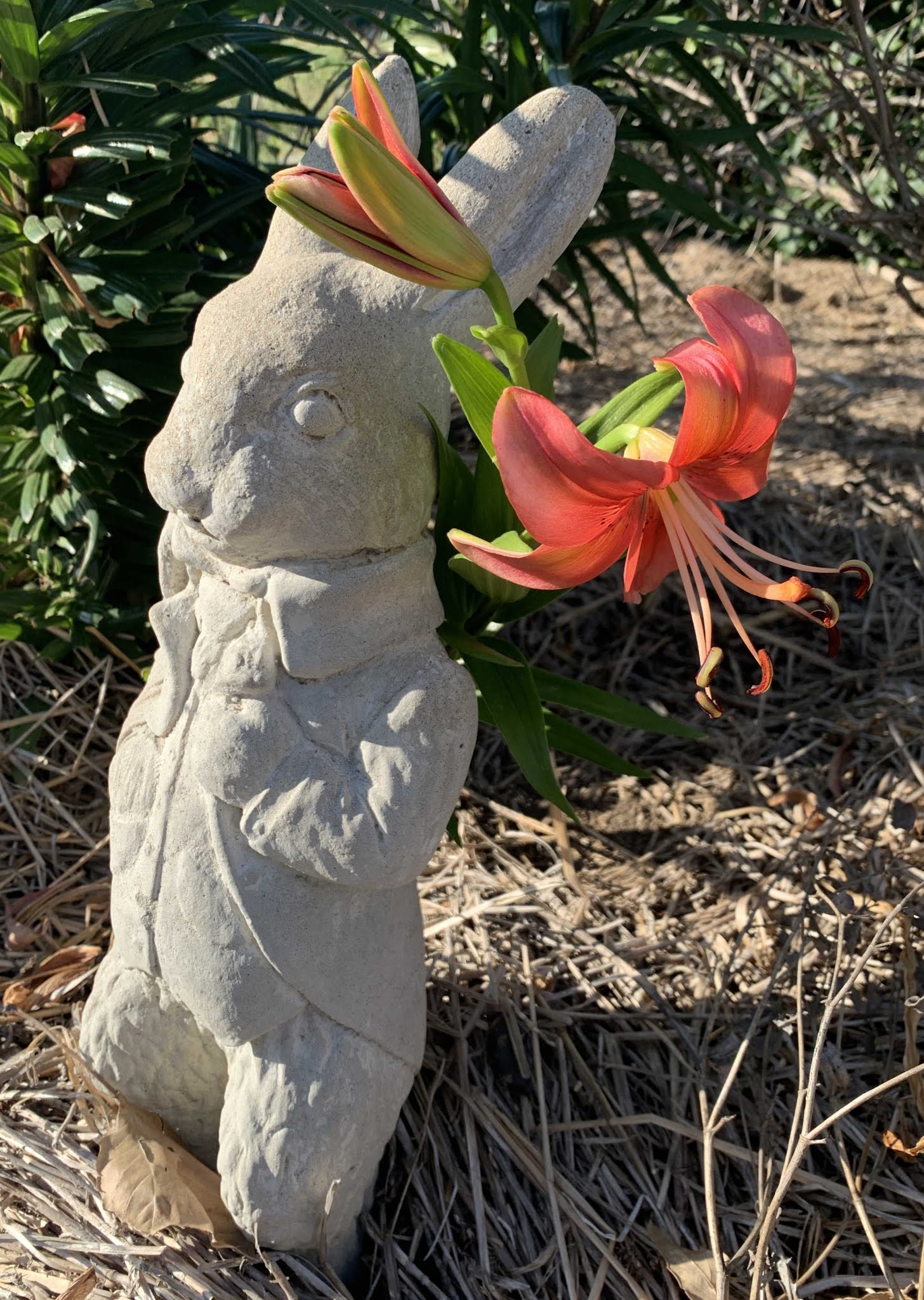
There is, too, in the garden at many corners, feasts for the soul, saving sights for sun-seared eyes. My gentleman rabbit comes calling, a cheerful lily over a concrete shoulder. Blanc Double de Coubert, jealous of the angelic pristine poppy, attempts a second bloom cycle, not quite as white, but more fragrant and visible against the dark green foliage. Panicled hydrangeas begin to bloom, Russian sage forms a mound of airy blue, and everywhere grasses stretch to the sky.
Saturday, April 20, 2019
Showing the Crazy
Yesterday, I also did the craziest thing I've done in the garden in ages. While purchasing the straw at a local garden center, I couldn't resist the swan call of these two plants, a Crimson Sweet Watermelon, photo at left, and the Ball 2076 muskmelon pictured below.
Normally, I plant these from seed sometime in June, but they begged me incessantly to take them home. I checked the 10 day forecast, saw no nighttime temperatures below 42ºF, and so decided that this year, if by some miracle they survived, I might be able to beat the local markets for homegrown melons and thus not be too late to gain Mrs. ProfessorRoush's admiration and gratitude. Previously, by the time my seed grown melons are ripe, she has already bought several at the local markets and is sick of them, leaving me dejected and without praise.
Some of the straw went to mulch the garden all around the melons; at least the ground around them will stay nice and moist and cool all summer and I'll be able to avoid weeding among the vines. If I'm lucky, the straw will also make it harder for the rabbits to find these melons.Early bloomers continue to pop up everywhere in the garden since the frost has stayed away for a week or more. My Red Peach is a bright beacon in the back of the garden, a standout in the evening sun. Alas, last year in a storm, I lost the red peach tree in front of the house, pictured in the link, but this one is doing just fine.
And, to my surprise, I noticed this iris blooming (here, right and below, left) yesterday. I have it planted in a corner of the vegetable garden, an experiment from when we just moved to the prairie which I never got around to transplanting into a perennial bed. I don't know it's name, but here it is, in a hurry to be the first, several weeks ahead of my other iris.
Viburnums are blooming too; at least some of them, but that's another story for a later time. Check back here soon and I'll tell you that tale just as soon as I solve the mystery of why some are MIA.
Monday, April 28, 2014
Good Lilac Intentions
What was the old aphorism about the "road to hell being paved with good intentions"? Or maybe, "no good deed goes unpunished?"Each year, as the lilacs and peonies bloom, ProfessorRoush tries to brighten up the desk staff and waiting room by occasionally bringing in fragrant flowers (of appropriate purple, cream, or lilac colorings since those are the school colors). This morning, I gathered a bouquet of lilacs, light 'Annabelle', and darker 'Patriot' and 'Sensation', unceremoniously stuck them in a Mason jar, and drove them into school to place them in the waiting room.
I often wonder if the practice will have to end when a client will finally complains about the strong fragrance offending them or setting off their allergies (what a world we live in now!), but if that occasion ever occurs, the flowers can be easily moved. What I never dreamed of is finding, as I did several hours later, that they would attract bumblebees into the building. I suppose it is possible that this little guy could have been hidden within a blossom as I collected them, torpid from the cold night air. Surely, however, the warmer air of the Jeep would have awoken him as we drove. An alternative, but hardly more likely hypothesis is that somehow this bumblebee followed the fragrance and found these flowers through double doors about 30 feet away from the outside.If his presence had been widely noted, I'm sure it would have called for much clamor and strife, but luckily he seemed satisfied to perch on the same spot for awhile and then disappeared about ten minutes later, never to be seen again. I do hope he found his way back out through the double doors and stocked his larder up from the trip so he doesn't return later.
Monday, September 20, 2010
BumbleBee Harvest Time
While fall gardeners still value flowering plants for adding color to the garden, there is no better reason to keep fall-blooming plants in your garden than to provide that final fall burst of energy for the many creatures who need nectar for winter stores, whether it's the hummingbirds migrating south for the winter or it is the bumblebee at the right, sipping at the 'Blue Mist' caryopteris. In fact, take a closer look at that blue-collar workaholic bumblebee; covered in pollen from the many visits, it doesn't have time for a shower or a deodorant spritz, it's just buzz buzz buzz till the cold saps its energy. Bumblebees store only a few days energy in the nest and each individual must reach a certain weight before entering their hibernation state if they are to survive the winter. Astonishing efficient and cooperative, they leave a little scent deposit on every flower they visit, a gentle way of communicating to the next bumblebee to come along not to bother wasting time at that particular blossom. In the fall, they benefit most from lavenders, asters, sunflowers, hyssop, sedums, goldenrods and salvias, which accounts for the activity around my lavenders and for all the Blue Sage (Salvia azurea), goldenrod, and sunflowers blooming all over the Kansas prairie right now. I've not had a lot of luck with heather here in the Flint Hills, but a dense patch would help shelter the bumblebees in inclement weather so it might be worth a try in a sheltered area. Several sources noted that honeysuckles are also valuable in fall as a rich supply of nectar for bumblebees. And I noticed just this weekend that my 'Florida Red' honeysuckle was blooming again. Smart vine, that honeysuckle!
Of course, other flowers and plants are useful for these and other visitors. The Buddleia sp. keep up their display to attract butterflies like the late season Thoas Swallowtail pictured at the right. The milkweeds sacrifice themselves for the greater glory of the Monarch. And of course, nothing likes the honeysuckle better than the migrating hummingbirds. .jpg)
.jpeg)
.jpg)
.jpeg)


.jpg)
.jpg)
.jpg)
.jpg)
.jpg)
.jpg)
.jpg)
.jpg)
.jpg)