Wednesday, September 21, 2011

Story of My Summer

Before anyone panics, NO, this is not a picture of a KSU-physics-department nuclear test cloud over the Jayhawk's football stadium in Lawrence.

But as a rather useful illustration of the frustration that is gardening in the Flint Hills,for all of those who don't live in Kansas, I give you the picture below, snapped on my way home from work on September 9th. 


I had just gone north from the Vet School, took one look due west, and immediately grabbed my trusty "Jeep" camera, the Nikon CoolPix L22 cheapo that I keep in the glove compartment, and pulled over.  This random rain cloud, the first actual rain hitting the ground that I'd seen in over a month, is sitting just to the south of my house, which is just over the hill on the western horizon at approximately the right hand edge of the cloud.  By the time I'd gotten home 5 minutes later, the cloud had moved on, leaving a 500 foot or so wide sprinkle path over my neighbor's driveway and the pasture between us. 

It was another week before we finally got a decent rain, an all-night soaker that provided us a solid inch of rain to wet the topsoil down four inches or so.  It's an odd feeling to dig down into the dirt of my garden right now; moist soil for the first few inches, and then dry subsoil as far down as my shovel will reach.

Welcome to the Flint Hill's my friends...welcome to the Flint Hills, the most damnable excuse for a mid-Continental climate evident to gardening civilization.

Tuesday, September 20, 2011

Beds in the Sun III

To finish off my saga of the backyard bed layout requested by GaiaGardener, I'm moving to another picture, a continuation of the previous beds showing the beds laying to the south-west corner of that area.  The previous posts on this subject were Beds in the Sun and Beds in the Sun II.

I've already mentioned the bed labeled "J", my "Barden Bed" which is a group of 12 roses, mostly Paul Barden creations obtained commercially from Rogue Valley roses.  I've added a number of new daylily starts to the outside of this bed, hopefully to bloom after these once-blooming gallica and alba creations are long done.

Bed K is a long border, my "Viburnum Bed" the third oldest in the garden, composed mostly of mixed shrub roses and about 8 viburnums in full sun.  People always seem surprised to see the viburnums growing in full sun here, but they are troublefree in this location. It is anchored on the East (left) side by an 'Arnold's Red' Bush Honeysuckle, and on the West (right) side by a 'Golden Spirit' smoketree, the latter now 5 years old and about 7 feet tall.  Several Old Garden Roses are placed here, including 'Celestial', 'Duchess de Montebello', 'Charles de Mills', and 'Rosa Mundi.'  There are also a few assorted other roses, including the rugosa 'Sir Thomas Lipton', 'Dornroschen', and Buck roses 'Carefree Beauty', 'Griff's Red', 'Freckles', and 'April Moon'.  A couple of nice grasses, Panicum 'Northwind', and Miscanthus sinensis 'purpurascens', along with a Sumac 'Tiger Eyes', provide some late Fall color along with the viburnums.

Bed L is my most formal bed, composed of nothing but Buck roses, English roses, Modern Shrub roses, and a very few Floribundas and Hybrid Teas.  If it's a modern hybrid-tea-like rose, it is likely in this bed, surrounding a concrete bench.  There are a few OGR's here as well, 'Leda',  'Variegata di Bologna', and 'Henri Martin' as well.  There are, at last count 58 living roses in this bed.

Bed M is a long bed laying among the three taller beds and it is the oldest of what were my mixed iris and daylily beds.  Here again, the iris keep fading out, overwhelmed by the daylilies, and so I'm converting the bed to daylilies only.  I mow this one off every fall as mentioned in previous posts.

The last of these beds, Bed N, is my "Rose Berm" and it is the oldest bed in this part of the garden.  It was created 10 years ago by a gift from my mother of two truckloads of topsoil spread in a long hump, so it is mostly a raised berm about 2 feet higher than the surrounding prairie.  Along with the topsoil, I got lots of bindweed seed that I have to continually watch for even a decade later.  This bed is anchored by a 'Purple Fringe' smokebush at one end and a 'Blue Bird' Hibicus syriacus at the other, but otherwise there are about 30 roses in the bed, ranging from several Canadian Roses such as 'Alexander MacKensie' and 'Morden Ruby', to Old Garden Roses such as Bourbon 'Louise Odier' and Damask 'Madame Hardy', and even a couple of (gasp) Knockout's; 'Double Red', and 'Double Pink'. My Rosa eglanteria is here, as well as one of my two 'Austrian Copper' bushes, and a 'Harison's Yellow'.

So that's it, my main garden.  I'm going to wait awhile and talk about other things, but eventually I'll give you an overall glimpse of my front, back, and side landscaping beds.   Hope this helps place things I've mentioned in this blog!

Sunday, September 18, 2011

GGW September Photo contest

Like others who took on the challenge of Gardening Gone Wild's September Picture This Photo contest, I had a hard time choosing between entries.  The guest judge, Christa Nue, picked a very open subject, "Late Summer Garden," and then made it harder by providing examples ranging from closeups to colorful garden beds, to wild vistas.  Late Summer and Fall subjects are apt to be more difficult in the Flint Hills, a landscape which is often at its best in Fall as the late cool rains turn the grasses and hillsides red in contrast to the late sunflowers and goldenrod that rise amongst them.

As an example, I briefly considered this more natural vista of wild goldenrod on the prairie.  I got lucky with an early morning mist for this picture, taken across my neighbor's pasture.  This golden, unplanned field is composed of a mix of native goldenrod species, including Downy Goldenrod (Solidago petiolaris), Rigid Goldenrod (Solidago rigida), and the ubiquitous Missouri Goldenrod (Solidago missouriensis). 

When I think of a Fall garden, I often think of rose hips, so a recent picture of Rosa eglanteria hips appealed to me on a closeup level. Orange skin and wicked curved barbs, rose hips hold the essence of the fading sunlight.


 And for a pure late summer flower show, nothing rivals Hydrangea paniculata in the Flint Hills.  This cultivar is 'Limelight', no less interesting in late summer for the browning, drying petals, their demise hastened by the drought which still lingers.  Seeing this, I remember why they're popular subjects for dried flower arrangements.


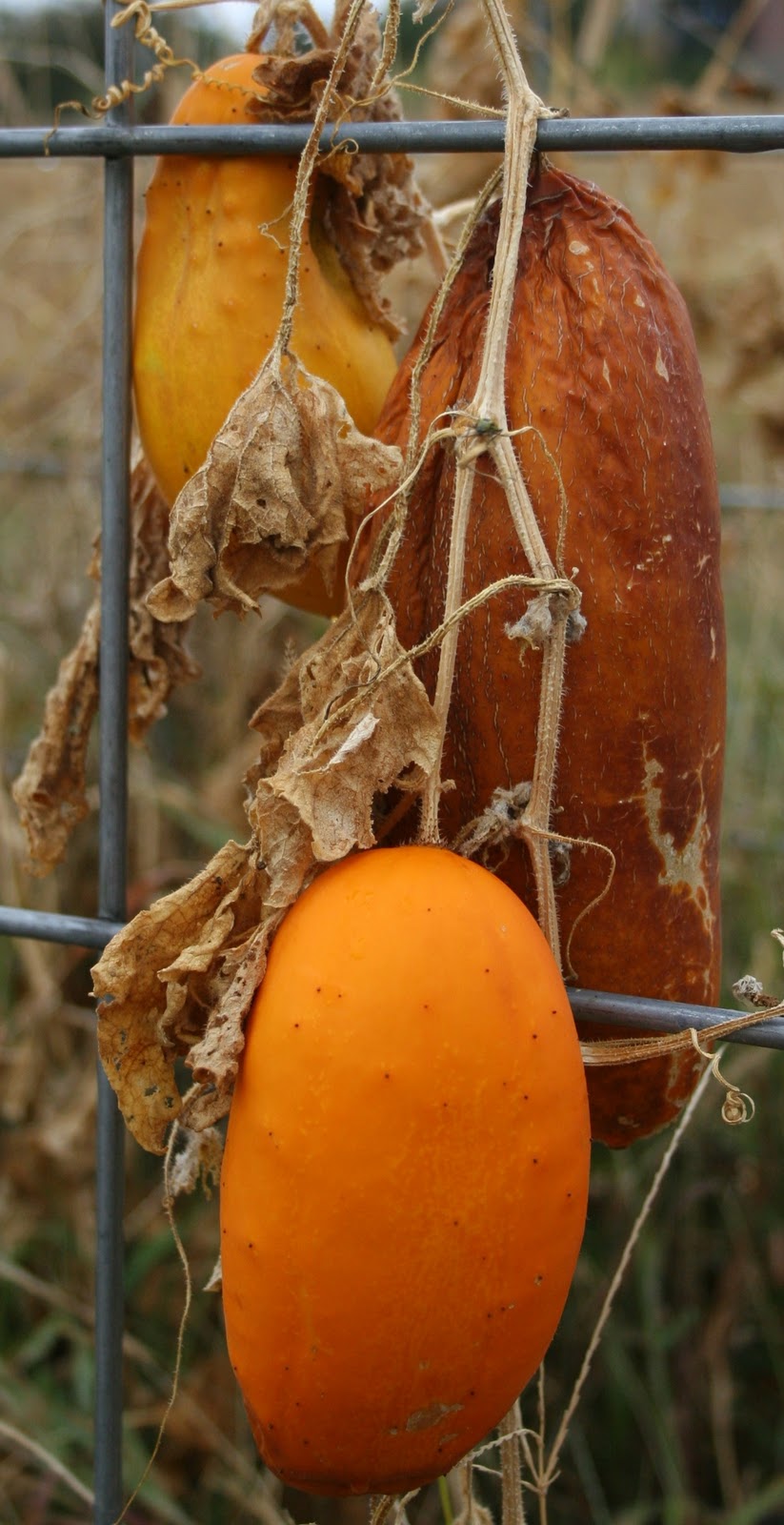
Roush GGW September Entry 'Goodbye Summer Harvest'
But, I finally settled on entering the picture at left  into the contest; an overripe, overgrown, group of forgotten cucumbers on a fence.  I know that the overall subject is a little unusual, but the title of "Late Summer Garden" suggested more of a vegetable garden feel to me.  And in the end, I couldn't resist the papery, detailed texture of the dried leaves and prickly stems of these cucumbers.  Make sure you look beyond the overall "orangeness" of the composition and click on the picture to see the full size version to appreciate the detail.  To me, this picture screams, "Summer Is Over!"  

(Rats, it's been automatically compressed because it is so large....really, the leaves look great in full size!)