Sunday, May 8, 2022

Longhorns Ho!

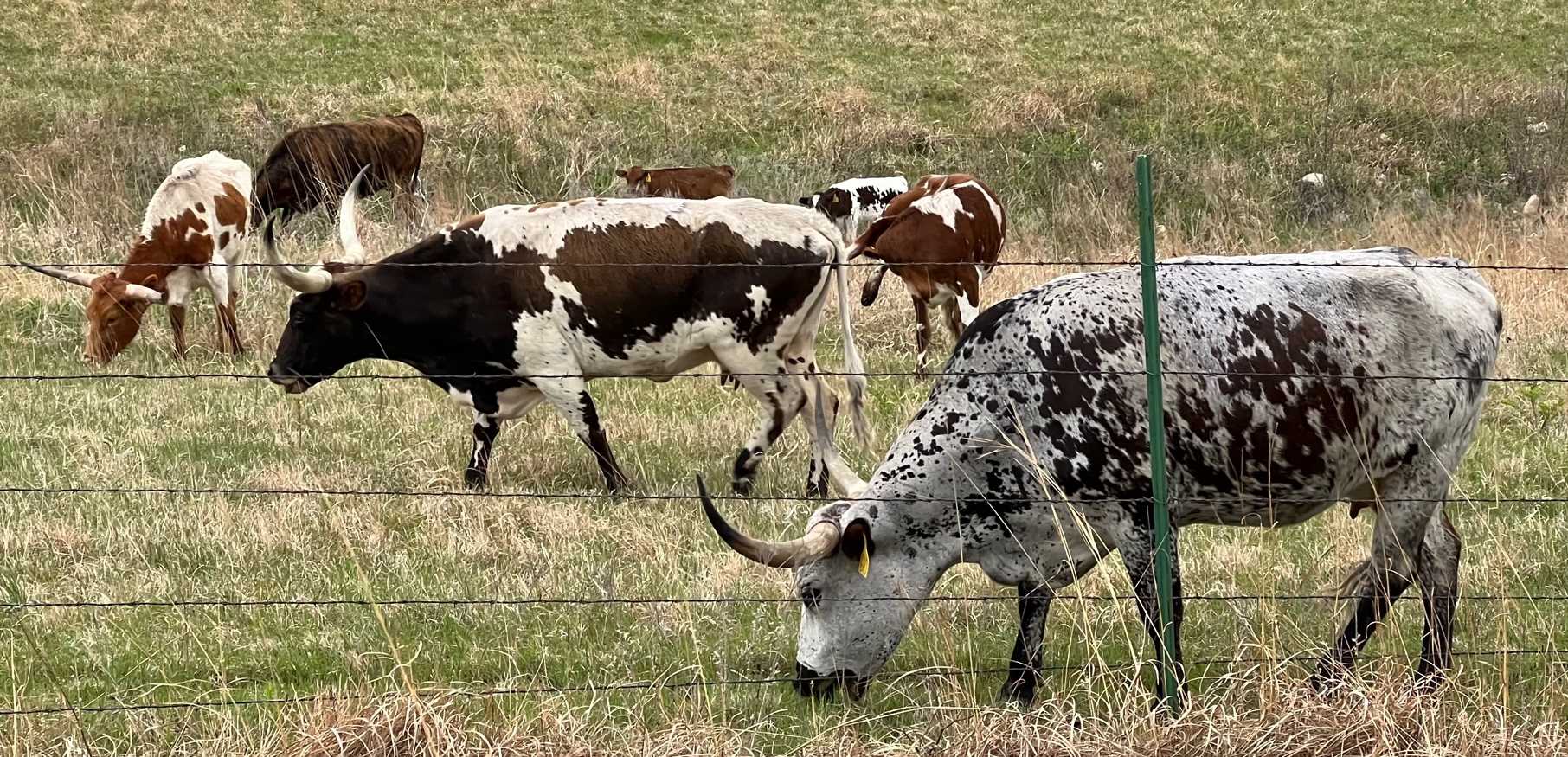
Yesterday was an outside day in ProfessorRoush-land, work to be done, and some exploration in areas that I don't frequently explore.  I mowed and piddled in the garden to my heart's content, the second mowing of the year starting at 9:30 a.m. and then doing other chores until I looked up at last to see it near 5:00 p.m., the afternoon vanished seemingly in seconds.   Most of the work was prompted by the arrival this week of the Longhorn cattle that a friend (actually the son-in-law of a neighbor), summer pastures on our land and the neighbors pasture.  Aren't they beautiful?  ProfessorRoush likes having cows around, even skinny cows with big menacing horns, and they make a conversation piece for neighbors far and wide, creating a little traffic on the road from the townies coming to "Aw" and stare.  

The Longhorn appearance, however, prompts me annually to walk the far fence, the one that I DIDN'T rebuild when we purchased the land, my border line with the golf course.  It's an original, easily over 50 years old, maybe more like 80 years old, with Osage Orange posts that occasionally get caught in the burns, and I often need to hike up the back hill with a new T-post to shore it up.  The picture below is a view of my back garden and the house and grounds from the far hillside.  Yesterday, all was well with the fence and I opened the gate to let the cattle into my pond area.


White-Eyed Grass
Walking that fence line means I walk down through the prairie and cross the woods in the draw and come as close as I get in this area to shady woodland.   This time of year, that means looking at the flora of the prairie more closely.  The prairie is coming alive with its flowers, native Babtisia starting to bloom, and this White-Eyed Grass (Sisyrinchium campestre) blooming everywhere.   White-Eyed Grass is, of course, not a grass but a member of the lily family, a bulb, used by Native Americans to treat stomachache and hay fever.


Garlic Mustard
I also ran across this unusual plant, an invader of course.  Garlic Mustard (Alliaria petiolata) is a biennial weed that came from the Old World and escaped cultivation.  It isn't very prevalent on my prairie, requiring a bit of shade and moisture to thrive, but it seems to have found a spot here in the woods for it's temporary liking.

And speaking of invaders, while on my travels through the pasture, I also came across this unusual plant, seemingly beginning to spread in this area.   This is Purple-Leafed Honeysuckle, an escapee from my landscaping, which I made sure to come back and spray with herbicide yesterday.   I believe this clump was actually transplanted by the bulldozer that cleared it out from a bank where I placed the barn and pushed it into this area, but I surely don't want to see it begin to spread on it's own in the pasture


Poison Ivy
The woodland plant pictured here is, of course, not so desired in a woodland, but it's everywhere, hiding among others and waiting to cause pain and misery in some.  As shown here, among several similar plants, it effectively camouflages itself in early spring and then stands out in early Fall with bright red leaves to match the bright red blisters of the afflicted. Luckily, I'm immune to the toxic effects of  the urushiol in poison ivy (Toxicodendron radicans), but I know it causes misery in others.  "Leaves of three, let it be," say some, but I say "Leaves of three, I don't care."  It probably has some place in the ecosystem, a native to North America, so I leave it alone.

Saturday, April 30, 2022

Fun, Disappointment and Home

ProfessorRoush has been away this past week, away from still cold and windy Kansas, to...well, I'll let you guess.  Where, might you guess, have I been this week?

Wormsloe Allée

If you guessed the South, you're correct, and some of you know of the Wormsloe Plantation ruins and its live oak allée.  You perhaps even recognized the statue photographed at the right.   I've been to Savannah Georgia, enjoying a few days traveling to new places with Mrs. ProfessorRoush while at the same time lamenting that I was missing the peak bloom of my lilacs back home.  The statue, for the unknowing, is Bird Girl, a bronze creation of  Sylvia Shaw Judson made famous by the book and movie Midnight in the Garden of Good and Evil.  At the time the book and the movie were famous it was located in the Bonadventure Cemetery of Savannah, but it is now exhibited in the Telfair Academy, an art museum we visited this week and where I took the photo.


Owens-Thomas garden and Enslaved Persons Quarters
Don't, please, think for a moment that ProfessorRoush is an aesthete, or that I, in fact, have any knowledge of art or appreciation thereof.   Most of art is lost on me other than the thought that I'm looking at a "neat painting."   We ended up at the Telfair Academy by accident, as the ticket is combined with entry to the nearby Owens-Thomas House (garden and enslaved persons quarters pictured above), which we DID want to see.  Although the art museum was lost on me, I did enjoy viewing the Bird Girl and I allowed myself to covet it for a brief moment for my own garden.  

Gardenia jasminoides 'Daisy'
I hoped to visit Savannah at the heart of the garden season, but I must admit I was sadly disappointed in the garden offerings there.   I missed by three days (although tickets sold out last November) the annual charity tour of private home gardens, which was probably spectacular, but the public gardens of Savannah were surprisingly few and far between and nothing to travel for.  The Southern Magnolias (Magnolia grandiflora) were in bud everywhere, but not yet openly blooming.  There is a small, poorly labeled "Fragrant Garden" in the world-famous Forsyth Park where I took the Gardenia jasminoides photo at the right and enjoyed the vining jasmine and a nice blooming but unlabeled specimen of 'Zephirine Drouhin'.  However, honestly and without the slightest hint of humility, I have to say my Kansas lilacs and garden here rival the best that Savannah could produce for fragrance.  There's no place like home.

I had hoped to finally see, in person, a few Hybrid Noisette roses in their native south, or at least a good display of other roses in a warmer, wetter and kinder environment than Kansas, but I was completely disappointed everywhere we went.   I spied here and there a few barely-surviving English roses and some ugly Drift and Knockout roses.   But even the Savannah Botanical Gardens had a less-than-inspiring collection of a few straggly Hybrid Teas, barely surviving in too much shade.   It was at the SBG that I took the completely appropriate picture at the left.   The label says "Iceberg, Possibly Best Floribunda Ever," and the fact that the actual rose is completely absent here sums up my feelings about 'Iceberg' after I've tried several times to grow that overrated bush unworthy of being called a rose.  

One highlight of the trip, however, was a turn off the main road made on a whim to the Pinckney Island Refuge, which we happened to drive by as we came home from Tybee Island.  There, we saw this rookery of Great Egrets and Snowy Egrets, socially nesting safe above the alligators waiting below in the pond.  I was tickled by the three fuzzy little egrets sticking their heads up in the lower right corner of the photo.   Click on either photo to blow it up to full size!


Now that I've mentioned both birds and magnolias, I'll close with photographs taken today of my 'Yellow Bird' magnolia, just past its blooming prime, and of my "lilac row", also past prime.  When we left, not a single bud of 'Yellow Bird' had opened, yet six days later I return to find that I almost missed it blooming this year; an unspeakable tragedy narrowly avoided.   Since the wind here has blown in gusts of 30-40 mph all day today after a thunderstorm and tornado watch last night, I expect another day of vacation would have left me missing the show.  If I can't see magnolias in Savannah, at least I've got them here.

'Yellow Bird'


Saturday, April 23, 2022

Finally, Spring

Lilac 'Betsy Ross'
At last, Spring has arrived in Manhattan, Kansas.  It is and was a long-awaited, miss-conceived, desiccated Spring, but I'm declaring Spring nonetheless.  I have to, for if I waited any longer, I'd be in mid-summer and sweltering. This is no longer  a Spring of a few wee annual bulbs now, this is full-blown everything growing Spring.   No spring rains yet, but hopefully the ground will get re-saturated before July steals it all away.   There is plenty of wind blasting past, however, wind that kept me awake all last night and wind that has kept my roof from being repaired for over 3 months since the December gales that lifted a few shingles.   And frosts galore, frosts that ruined my annual celebration with Magnolia stellata and has dampened the impact of purple 'Ann' this year.


'Betsy Ross'
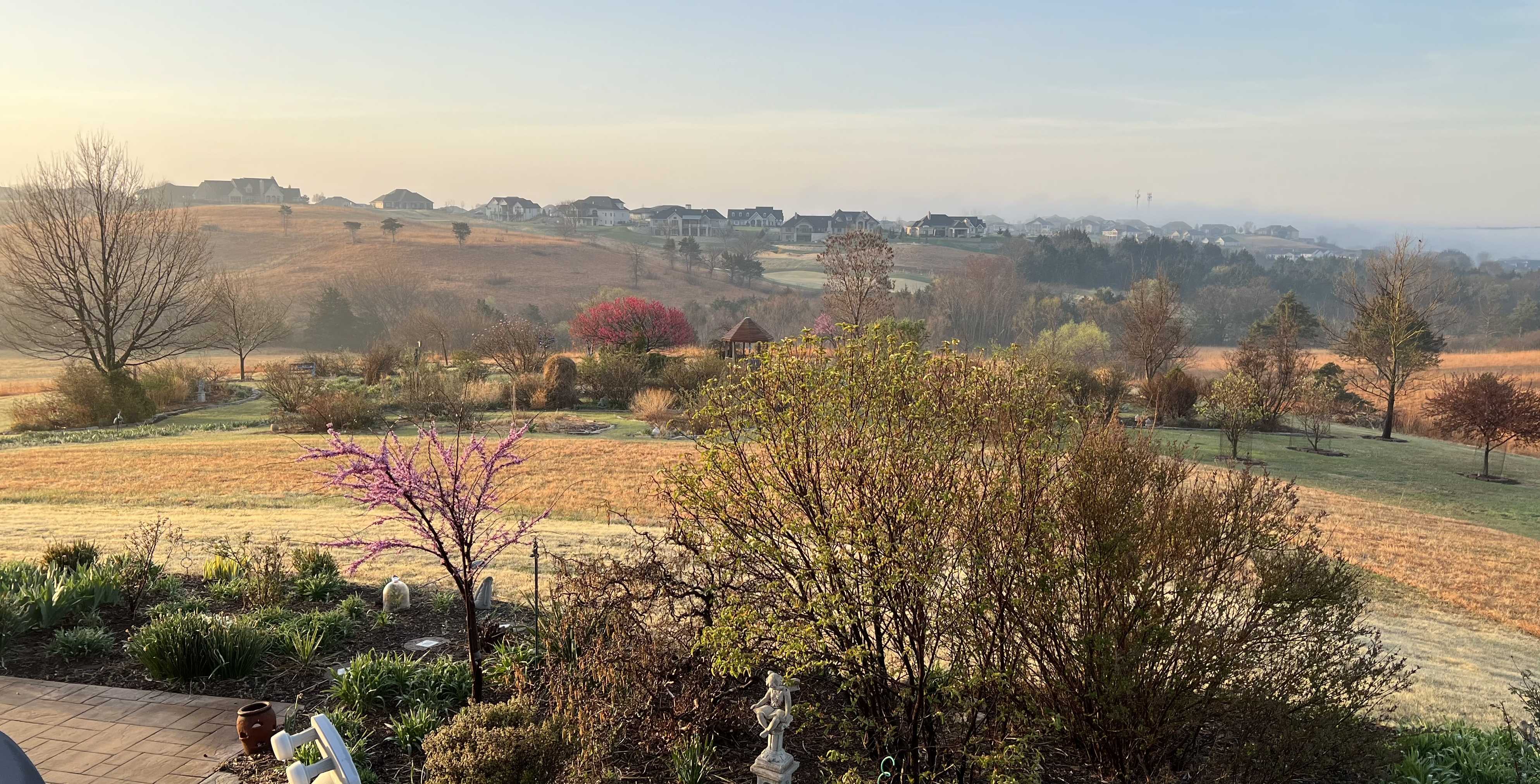
I was struck, two mornings ago, by the morning light and beauty of my awakening back yard.   Color drew me out to take the photograph above, pastels and spring pinks, a cool morning but sufficient to celebrate the collage of spring colors in the back yard; volunteer redbud in the foreground, occasional blush of magnolia in the borders, my red peach in full bloom in the back.   And the houses on the ridgeline south, across the golf course, visible now, but invisible to my inner eye which still sees the bare hilltops I used to see here.

My primary focus this morning is on my lilac line, the end of the garage pad at the house, beloved pink and white 'Annabelle' at the back.   Some are in full bloom, some just partially open and others yet to start, but a mere whiff of air on that side of the house saturates you with lilac and converts every racing thought to a lazy dream.  The "Most Spectacular" award this year goes to Syringa oblata 'Betsy Ross', a  2000 U.S. National Arboretum introduction from the 1970's breeding program of Dr. Donald Egolf.   My 'Betsy Ross', planted in 2013 and photographed this cloudy morning.  She is certainly now well worth the Andrew Jackson photograph I traded for her when she was a small plant.   Perfect white panicles, non-damaged this year by frost, wind or rain, and as fragrant as a bottle of perfume.   I can't ask for more.

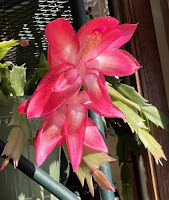
It is, in fact Spring outdoors and indoors right now.   This rare (I think) yellow Christmas cactus is now blooming for the third time since November, and the colors are even more rich and deep than it's first bloom.  Fully 80% of my Christmas cacti are still cycling bloom, months and months of delicate color to fill the sunroom.

I leave you, this cloudy morning of Spring, with the last of the daffodils that live in the coldest, darkest, northern exposure of my landscape.   Last to bloom, they are protected there from wind at the least, perfect blooms and cheery faces to remind  me they will be back next year again.   Yes, we've had a few sprinkles this morning to brighten them up, but the ground beneath is bone dry, crying for moisture, for the re-quenching rains that should come with Spring.   Is that still too much to ask for? 


Sunday, April 17, 2022

Dabs and Dribbles

'Cole's Red' Quince
Spring, this year, is a fight within our witness, a struggle by life to leave behind the cold winds of February and March and move to sunlight.   There has been no knockout blow, no sudden blitzkrieg of either heat or snow to change the fortunes of garden and man, but the to and fro, the feint and parry, of the seasons continues with no easy end in sight.   We will not see spring, I fear this year, in broad strokes of pastel color, but in dabs and dribbles, slowly meting out its glory in smaller packets of pleasure.


'Betsy Ross'
It is both dry and cool now, continuing the pattern of past weeks and it seems, promising the weather for weeks to come.   The sky has not provided enough moisture to yet ignite the irrepressible forces of life, nor has the sunshine been overly generous with its sustaining energy.   It benefits me little to blame the cheerful weatherpersons for the slow strides towards summer, nor do I deign to fret over the millions proclaimed to be in severe weather danger each day, not while I'd happily risk bad storms to quench the thirst of the ground.  I wait instead, patiently, for these pictured buds to open and clothe the garden and world with beauty.


'Annabelle'
The quince alone is fully open and meeting my lust for rusts and reds, Chaenomeles japonica ‘Coles Red’ in this instance, pictured at the top.   I appreciate quince but it struggles here, the prairie a smidge drier than it likes, the winters and deer a little harsh for its full comfort.  Stronger for us are the lilacs, but they are still biding time this year, afraid perhaps to fully commit lest a late snow or freeze catches them in full exposed blossom.  It would not, of course, be the first time I've seen snow on lilac panicles.  Naked and afraid, 'Betsy Ross', above, and 'Annabelle', here, are providing only a glimpse still of the promising maidens they could become.  One night in the next 10 is presently predicted to be below freezing, so I am content in this instance to indulge their teasing and patiently await their full exhibition.
In similar fashion, the red horsechestnut leaves remain tightly furled, the rough, prehistoric texture safe from frost and marauding deer, and my beloved red peach is mightily trying, but failing, to become a beacon of spring for the neighbors.   It is covered, as you see below, in buds, but yet to glow, the cloudy skies and brisk winds battling against its nature, its reason for survival, those buds to become seeds, those seeds to be trees.

Red Peach
And so, I wait here, still wait this Easter, for the annual rebirth, the rebound of the world.  With Easter comes promise, a guarantee of life's return, a revival, not promised this year perhaps in trumpeted herald, but softly spoken in dabs and dribbles.  Regardless, I close singing in full voice along with Sara Evans, her lyrics:  "Hallelujah, a little revival....amen to love."

Sunday, April 10, 2022

Excuse My Untidyness

Finally, finally, finally, a small start to spring.   I found this first Magnolia stellata bloom on April 1st, and today on April 10th the bush is starting to look at least midway to peak bloom.   Late, but luscious, I inhaled all the musky scent this flower could give me as I dreamed of more to come.


You'll have to excuse me for the straggly appearance of this brazen forsythia, in full flower finally today on April 10th.  I have at 5 different cultivars of Forsythia out in the garden ('Spring Glory', 'Meadowlark', 'Show Off', an unknown gift shrub, and several 'Golden Tines') and this single 'Golden Tines' is the only one to bloom with any show this year.  Why this one?   The others are straggly at best, almost barren at worst, so thank God for this front and center golden jewel.    Yes, I didn't trim it last fall, didn't remove the long shoots of late summer, for I planned to bring those inside and force bloom this spring.   Obviously, the cold and winter doldrums kept me from following through on that well-intentioned plan.   And I'm ashamed of the unclean bed around the forsythia;  I just haven't gotten even the front landscape bed ready yet for spring.

While I do hope for a bold yellow forsythia bloom each spring, I'm never surprised when the "pink forsythia", Abeliophyllum  distichum ‘Roseum’ blooms only sparsely and briefly,  This year it lived down to my expectations, barely attempting any blooms and showing none of its usual pink blush, white fragility in the flesh.  I've had this shrub for 13 years, so it is hardy here, but certainly not vigorous and it hardly provides any show, early bloomer that it is.   It was already at peak bloom here, on April 1st this year, and already nearly barren as it yields to the rest of the garden.  Sweetly scented if you get close, Abeliophyllum is a distraction for me, the earliest shrub to flower and the only one until the M. stellata gets going.  I keep it for that reason, something for my soul to grasp onto as I desperately wait spring.

Despite my earlier whining, my Puschkinia finally did bloom, shown here in a front bed near the edge where it begs you to bend over and look closer.  Alongside the Scilla, it raises my spirts for a few weeks as I drive home for work each day, right by the garage pad where it can catch my glimpse and welcome me home.

Closeup 'Abeliophyllum distichum'
Outside today, it's warm at least, climbing about 70ºF, but yet I'm not outside clearing beds or doing useful work.   The wind, a southern wind, is moving along at a brisk 20mph pace and I just don't feel like fighting it with every step I take.   No, I'll stay mostly inside today, waiting fitfully for the lilacs and redbuds to begin the real spring season.   My redbuds are slowly showing some color in their buds, but they are reluctant to join in yet to the seasonal celebration.  For reference, in my seasonal notes going back to 2004, the daffodils and Puschkinia were behind this year, while the redbuds are even with some years, behind others, but only in the very cold spring of 2008 did they definitely bloom later than this year.   So, I'd say that we are late, but catching up.   Too slowly, however, for my taste.  My father always says it won't be spring until Easter and with the late Easter this year, once again, he's right on target.

Sunday, March 27, 2022

Two Weeks Later....

Two weeks later...and spring feels barely farther along that it was.   Oh, there are subtle signs; an early daffodil or two, lilac buds swelling green from their previous hard brown shell, a glimmer of action in the sprouting of daylilies.   But here we are March 27th, a week past the equinox, and the best that my Star Magnolia can conjure up is this single bud at the top of the bush, partially open and singed from the last frost.  That magnolia scent though, that sweet musky odor, was already present as long as I was willing to chance my nose into the bud.  And I was (willing). 

Dressing later to go to a movie, I splashed on a little aftershave and later, smelling it on my hand, I realized for the first time that the Brut® that I've used all my life has a strong aromatic resemblance to magnolia musk.  Musky, earthy, heavy, the scent of magnolia reaches deep into my id and presumably that of others.  Not stupid those aromacologists, those noses that know the attraction of certain fragrances.  Males of my generation shy away from sweet flowery scents, but throw a little musky magnolia scent my way and they have a customer for life.  Well, that, and that's what my father always used.  Shades of Oedipus, is that heritage from a generation ago the reason for the long survival of that brand in a crowded market?  Is America and civilization-as-we've-known-it safe as long as Brut® sells well at Christmas?

This French Pussy Willow 'Curly Locks' (Salix caprea) is also ready to open up and have its early way with the gardeners affections, but it, too, is late and slow to reach the climax of its bloom period.  As I search my records, there was only one year in the last 10 that Magnolia stellata first bloomed this late.  Most years, on March 26th it reaches peak bloom and it has bloomed as early as March 6th.  Similarly, in most years, forsythia is already blooming well and this year it shows no signs of breaking dormancy.  I wish I could tell you the normal initial bloom date of the Pussy Willow, but sadly, I've seldom noticed or written it down.  Please do as I say and not as I do and be consistent in the plants you keep notes on annually.   For me, the only consistency is the Scilla and the Star Magnolia, both because of their timing and their annual show.

There are other signs of spring life on the prairie, however, and most notably the spring burns have started.  I took this picture yesterday as I arrived home from errands standing on the garage pad looking west.   Many times, I see these tall clouds of smoke billowing when I'm leaving work or on the east side of town and I'm calculating where these clouds lie in relation to my own house, praying that the neighbors haven't gotten out of hand.  This one, however is far away, on the hills to the southwest of town, near the airport, 4 or 5 miles away as a crow would fly.  Prairie fires always strike a little fear in my heart, but they provide comfort too, comfort that the world is normal and spring approaches once again.

Sunday, March 13, 2022

Vainly Searching

By "vainly searching", ProfessorRoush means that he is searching futilely, fruitlessly for spring, not that I'm boasting or conceited or vain about my search.  We had the largest snow of the year last week, on March 9th, 5 inches of snow that fell overnight and melted completely away under the 69ºF temperatures of today.  At least we received the moisture, badly needed moisture that will start the prairie grasses under the path to summer.  But most things are buttoned up tight, the lilacs showing no hint of green under their hard buds, and even Magnolia stellata, pictured at the right, shows no signs of spring, the fragrant flowers still tightly cloistered within the hairy buds.

In the garden, I had to search a long time for any sign of spring at all.   Not even the snow crocus have yet made any appearance that I've detected.  I can only share these first sky-blue buds and yellow shoots of Scilla, just breaking the surface on the sunniest and warmest slope in my garden.  There are a few brave daffodil fronds pushing up here and there, but no peonies, no Dutch crocus, no Puschkinia.  Nothing but the squill to assure me that spring is coming or that the Earth has succesfully made it once again all the way around its star.

All of this is to say that I think spring will be late this year, or at least start up closer to average.   In 2012, I found the first Scilla blooming on March 7th.  In 2016 it was March 6th and the Star magnolia was blooming along with it on that date.  We are going to be later this year than earlier, compared to my notes of the past two decades on this spot of ground.  

So, I have only the garden of my mind at present, and this week it was outwitting squirrels.   No, I don't mean I have a squirrel infestation here at the end of winter, I am referring to Anne Wareham's Outwitting Squirrels (and Other Garden Pests and Nuisances).   I learned of the book on Garden Rant, where it was noted that it's not available in the US at present.   But, Amazon, came through with a paperback copy for me last week and I've been learning about "Weeds You Don't Want", and ridding my garden of cats.   Anne, thank you for a delightful, humorous, and easy read, short quick chapters in an older text of yours (2015), but new to me.   It brought me one week closer to spring.


Sunday, March 6, 2022

Hortus Populous

ProfessorRoush was in Washington DC this week, normally my favorite city to visit, particularly if I have time between conferences to hit the mall.   I've been there a number of times and have visited almost every monument and museum, some in the days before terrorism and nannyism ruined access to them.  I have walked the steps of the Washington Monument to the top and yet lived to tell the tale.

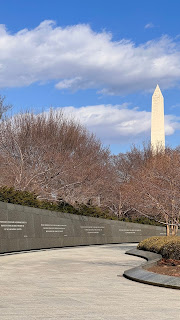
On the plus side, the weather was decent in the early part of the week and, as you can see from pictures, I did get an afternoon to wander about, visiting a number of my favorite monuments and the Museum of Natural History.  

In fact, I ran flat into the FDR Memorial, not previously knowing it existed, and I was moderately impressed by the mountain of red granite moved for its creation into the former swamp of DC.   Certainly and appropriately the most ADA-accessible monument, I recommend walking through it, particularly spaced where it is on an almost direct line between the Lincoln and Jefferson memorials.

On the negative side, I was, as usual, too early for the cherry blossoms, seeing only a stray early bloomer or two in a protected depression near the Constitutional Gardens.  And it turned cold and windy during the latter part of the week, and I learned that the cold winds of Kansas have a rival in the winds coming off the Potomac on a cold day.


Most exasperating, however, was discovering that the United States Botanical Gardens conservatory has been closed to the public for over 2 years, at least according to its website.  The outside gardens are open, but not the USBG conservatory.  When I go to DC, I always check the schedule of lectures at the USBG, just in case I get lucky as I did when I once saw Roy Klehm lecture.  This time, however, the website has not been updated for quite some time and there is no mention of a reopening date.  It seems that the USBG is within the "U. S. Capitol campus" and the fools on Capitol Hill, elected and despotic, are deathly afraid that perhaps a massive revolutionary coup will be staged from within the Children's Garden or perhaps the Orchids Room. Good grief.

My dear Representatives, Senators, Supreme Court Judges, and Executive; 

When in the course of gardening it becomes necessary for peoples with calloused hands and sunburned faces to dissolve the political idiot-cracy and allow visitors to the public gardens to which the Laws of Nature and of Nature's God entitles them, it is our right, nay our duty, to throw open the gates and allow the people inside.  Hortus Populus, Mors Tyrannis (Let the People garden, Death to Tyrants)!  You are right to fear the peasants who are most familiar with the proper use of pitchforks and shovels. Let Freedom Grow!

Saturday, February 5, 2022

Indoor February Color

February already?!   It feels like Christmas has barely past, that 2021 was still a newborn just past the birth canal of 2020, let alone now a senile monarch passing the throne to 2022.  We have yet to lock horns with winter, a few days of snow here and there, fleeting and flown, but soon I expect crocus and Scilla and budding daffodils raising their heads.  

For now, it remains the duty of the Christmas cacti, or Thanksgiving cacti, or whatever the things are, to bring color to a brown landscape and brighten the morning.   My collection, as it could be termed, of Christmas cacti expanded yet again this year, with the addition of a pale yellow cultivar to the whites, reds, and pinks, and one beautiful new small plant that bears blossoms of an unmistakably orange hue.  


All are blooming again, now for the second time this year, with the exception of two.  One is the orange variety which sulks in the kitchen where Mrs. ProfessorRoush has not allowed it enough sunlight.  It is, I'm sorry to say, a Schlumbergera which is...slumbering...in a post-gluttony phase of bloom.   And I'm chagrined because I was sure I had a picture of it, taken at the peak of color, but, alas, the picture is gone, lost I say, to the silicon and ceramic wafers of computer memory.   I'll try to edit this post later as it blooms again and add it in.

The second current nonbloomer is the very fuchsia variety I've had for a decade.   It has also bloomed, and is in bud again, but I've stolen the picture here from an earlier blog entry; purloined electrons to jog your memory.

For now, veuillez m'excuser, but you must content yourself with the white, yellow, red, and fuchsia varieties.  The reds and fuchsias are, I recognize, only distinguished from each another by subtleties, small differences in the percentage of white on each petal or the shade of carmine or cardinal it most resembles, but I celebrate the individuality of all.   The reddest is at the top of this blog entry, while two other varieties, each a little more white to the petals, also vie for the "best Christmas colors" display.

Ladies and Gentleman, I give you the colors of February, hues of life to carry you through to that first glimpse of yellow daffodils....


Sunday, January 30, 2022

Near Sunset

Sometimes the "near" sunset on the prairie is more stunning than the sunset itsel


LinkWithin

Related Posts Plugin for WordPress, Blogger...