Tuesday, June 9, 2020

Survivor Again

I'll speak now of one of the most beautiful rose blossoms in my garden, not the bush itself, but oh my the flowers, perfection in red, a scarlet lady adorned with gold.  I've spoken of 'Survivor' before and told you of how she survived shaded by two large roses, neglected in my garden for a decade.  Today, she stands worshiped, worshiped for the pollen she carries by her 6-legged admirers and worshiped for her grace under fire by me.  This bee wouldn't leave her alone today, molesting bloom after bloom in search of sustenance for the family.  And little wonder, click on the photo to enlarge it and examine the gold dust sprinkled on those regal petals!


I have three 'Survivor's now, proliferating solely at my pleasure, an occasional division allowed to place throughout my garden.  What she lacks in form, in body, she makes up for in splendor.  The barely semidouble blooms start out tucked away but they open quickly to a very showy bloom.   Is she gorgeous?  Yes.  Is she tough, yes?  Is she red?  Red and then some.

She only produces one crop of these bejeweled flowers each year, but she blooms over such a long period that I simply don't care.  The blooms hang on and hang on, lust on display for weeks.  The first photo of this bush, taken on 5/24, was almost a week after the very first bloom on it; the second photo from a different angle mere days later, and the third, taken on 6/]7, still in full flower and under full sun and absolutely no fade of the scarlet in those velvet petals despite the 90ºF temperatures for most of last week.  It was only today that I noticed the petals were turning to fuchsia and beginning to drop, her peak at least over and out.

5/24/2020
5/26/2020


6/7/2020

As I said, not much form as a garden bush, but I'd put up the individual blooms over any other rose in the garden.  'Survivor', she is and survivor, she will be, sunup to sundown, spectacular and deliciously red.  As the garden pauses between roses and summer, she carries on, bridging one cycle of the garden to the next, carrying the fire in a relay until the flames reappear in the nearby budding daylilies, red forever into fall.

Saturday, June 6, 2020

Moje Hammarberg

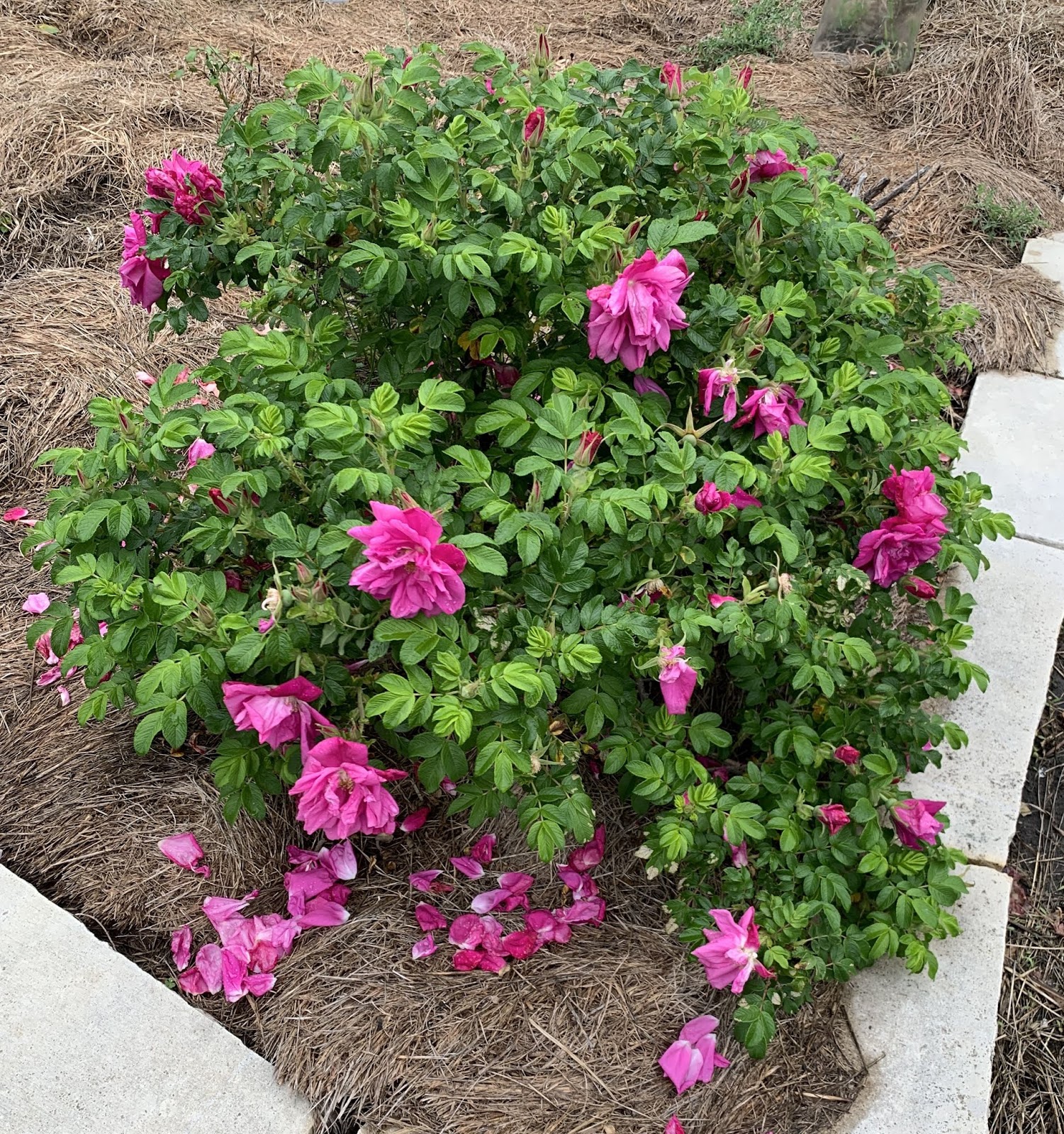
ProfessorRoush is proud to present to you, 'Moje Hammarberg', an astonishingly well-behaved Hybrid Rugosa born of Swedish origin in the same year as my father, 1931.  I planted Moje (pronounced "moyeh") two years ago as a mail order waif, wondered if he would survive the first winter here, and then fretted as he waited out the sodden swamp of solid clay where I planted my rose garden.  Despite my pessimistic expectations, however, in this instance his obvious Rugosa genes have come through and he looks like both a keeper and a survivor.  Well, a keeper so long as he continues his current healthy manner.
Moje may be a native Swede, but he fits none of the typical statuesque stereotype that a Midwest American expects from that far Northern country.  Moje is not a Viking warrior reincarnated in rose form, he is more representative of a squat little hobbit hiding behind the more heroic figures in the garden.  Of unknown parentage, the only thing for certain about Moje is that he must have some Rosa rugosa 'Rubra' in his immediate forebears, expressed in classic thick, wrinkled  and very dense foliage and a distinct tendency towards the mauve petals of the Rugosa genes.  There is, as expected, no blackspot or disease on this rose and he seems impervious to rose rosette virus as expected of that foliage.

Unlike many of the Rugosa's however, Moje is a complete gentleman and very diminutive in habit.  Rounded  and contained, at two years of age, he stands about two feet tall and two feet wide, healthy, but not overly vigorous.  His eventual size is reportedly only 3' X 4' from most sources (Peter Beales is alone in listing he could reach 6' tall), a tiny compact mass of restrained Rugosa hardy to Zone 3b.  In fact, he's shown absolutely no signs of suckering as yet, one of only two Rugosas in my garden to completely avoid that irritating tendency.  In that regard, he resembles my 'Purple Pavement', front and center in another bed only 20 feet away from Moje.  Perhaps those two polished specimens will have a good influence on the comely but aggressive 'Fru Dagmar Hastrup' in their vicinity and serve as an example to repress her wanton ways.  
The large blooms of Moje, however, are not nearly as tidy as the plant and are, in fact, a fairly unimpressive 17-25 petal mop head of mauve crepe similar in appearance to the larger and more vigorous 'Hanza'.  Suzy Verrier, writing of Moje in her Rosa Rugosa, charitably describes the 3-4" wide blooms as "lovely, large, and asymmetrical,"  which is a very nice way of saying that they have form, but no substance, color without sophistication.  Peter Beales, in "Roses" describes the blooms as "nodding," and I would agree that they seem to hang from the bush to some degree.  Moje does, however have a strong spicy Rugosa fragrance and reportedly forms large hips in the fall, which I have yet to see.  He repeats sporadically but always has a few blooms around to display, albeit the display is nothing to get especially excited about.

You can probably tell that I'm less than enthusiastic about Moje Hammarberg, disease-proof as he may be.  It's not that he's a bad rose, he's just...uninspiring, although the members of  helpmefind.com/rose disagrees and label him "excellent."  At this stage of my experience with him, I'd recommend him as a decent basis for a rugosa hedge, perhaps for those living in salt-prone regions, but I wouldn't expect him to be the centerpiece of a garden.  He's a workhorse, not a fancied up Dressage, prancing around in splendor.  

Sunday, May 31, 2020

Can You See Me Now?

I took Bella out the front door last night for her nightly squat, flipped on the lights, opened the front door, and followed her slightly rolling butt to the end of the concrete steps, Looking out into the breezy night beyond the lights.  As I turned around to give her some privacy in her eliminations, I glanced at the 'Stained Glass' hosta that I just purchased and planted last week, every the watchful gardener.  And then I looked closer.  Can you see it?


Now can you see it?  Just the body and one ear of a little bunny, frozen under the hosta leaves and desperately hoping that no one would see it.  I got a little closer to make sure it wasn't a pack rat, thought about picking it up, but ultimately decided not to make its little heart pound any more than I'm sure it already was and I left it alone.  I called Bella back inside, making sure to stay between Bella and the rabbit as my chubby love bounded past me to the door, and then I walked back in, plunging the baby bunny back into darkness and safety.

That bunny was hiding much better than this Gallica rose, screaming "I'm Pink!" for all the world to see.  No photo editing here, this little bright spot in my landscape is exactly as you see it, the brightest, most perfect pink you could ever ask for. 

Now if I only knew what this rose was named.  On my notes, this is the 'York and Lancaster' rose, which I obtained as a sucker from the KSU rose garden during pruning one year.  Only it isn't because 'York and Lancaster' is a striped or variably colored Damask and this rose only blooms bright pink and I'm pretty sure it is a Gallica.  In fact, my bet is that it's the Apothecary's Rose, or Rosa gallica 'Officinalis', a rose I have no written record of, but seem to recall obtaining at one time or another and must have found somewhere.  It has the right size semidouble blooms, is low-growing, and suckers like crazy.  I do have Rosa mundi, which is a candidate for the original 'York and Lancaster' rose, in another bed for sure. 

Regardless of its identity and provenance, it is certainly PINK.  And easy to care for, if I pull up the suckers from where I don't want them.  And disease free, although if you look very closely you'll see that the rose slugs started on it before I found them and intervened.  Some years it doesn't have quite the overpowering pink that it does this year, and it seems more vigorous and floriferous this year, but I'm not looking a gift horse in the mouth.  Pink is good, pink is happy, pink is pretty.