Monday, September 3, 2018

When a Kansas drought ends....

...it really ends.  If you've been wondering where I've been, I've been in Garden Depression-land, with only time to spare on weekends for watering everything that I didn't want to die.  It has been bad between the drought and the winds that took out several trees in my yard, among them my beloved ornamental Red Peach tree.  The only bright-side of my summer has been that I only mowed once from mid-July to late August.  Dry grass is tolerable when the mowee, i.e. me, doesn't have to sit on a roaring lawn mower for several hours each week.  


Two weeks ago, I happened to look in the local newspaper at the weather snapshot, to find out that, as I suspected, around 12+ inches of rain had fallen in Manhattan this year and we were 10+ inches lower than average.  So we had half our normal rainfall and all of our normal hot July temperatures by the middle of August.  I have been collecting weather radar pictures of storms going north and south of us all summer for the purpose of blogging about it, but couldn't bring myself to include you in my depression.  

And then, surprisingly, it started to rain.  Yes, here, in the Flint Hills!  In the past two weeks, we had several 2-3 inch rains that probably totaled 10 inches so I thought we were back on track, although the paper yesterday said that we were still 6 inches behind normal.  I forgot that annual rainfall is a moving target but at least we were catching up.  Suddenly everything is green again and I've had to mow weekly the past two weekends.
But last night the skies fell in!  From midnight to 6 a.m., the rain overwhelmed all my gauges, including the 5" gauge in the front landscaping on the blue hummingbird pole (2nd picture from top) and the 7.5" gauge in the back of the house at the top right. If you can't tell tell from the pictures, both are filled to their rims.   I have no idea how much rain we really had.  The pots with plugged drainage holes, above and to the left, also filled up to their brims, but at that point they were probably splashing out more droplets than were staying in them.  So your guess is as good as mine.  All this water was dumped into what is known as the "Wildcat Creek Basin," flooding an apartment complex, the town soccer fields, and a shopping center on the west side of Manhattan.  We even made the national NBC news tonight!  And now, some chances of rain are forecast 6 days of the next 7.  Can somebody please control the spigot better?

So, I'll try to blog from time-to-time again, since I have a garden and it seems to be green in places.  But I might get caught up in a whole series of new experiences.  For example, this morning, as I walked from the front yard around the house to the back, I was hearing the sound of a waterfall.  Waterfall>? Wait, what?  And then I realized; my neighbor's pond, which doesn't hold water and has been dry all summer, had filled up and was overflowing around the edge.  I, of course, rushed inside immediately to tell Mrs. ProfessorRoush that I had finally gotten her the garden water feature she's been wanting!
Incidentally, I thought about titling this blog entry, "When it rains, it pours."   Too cliche though, right?


Sunday, July 8, 2018

Digging Dry Taters

Fourth of July found ProfessorRoush out digging up some early potatoes.  I only planted 10 potato halves this year, to provide just a hill or two of taste at a time, and Mrs. ProfessorRoush wanted fresh sweet corn and new potatoes for a 4th of July dinner.  I could provide the potatoes, but since I had planned a corn-less garden year, the nearby market had to provide the corn.  Anyway, two plants worth of potatoes later, we had a nice  mess of fresh potatoes to eat.

Yes, I planted only blue potatoes this year.  I'm tired of 'Red Norland' and 'Yukon Gold' around here.  Blue potatoes are supposed to be "healthier" if you listen to all the hype,  but I suspect they're just another potato, a little more starchy and gimmicky than most.  I didn't know until recently that there were different varieties of blue potatoes, from heirlooms to 'Royal Blue' to 'Adirondack Blue', the latter bred and released by a trio of provessors from Cornell University in 2003.  The things you learn while blogging; because it retains color when cooked, the 'Adirondack Blue' variety is used by the Penn State Alumni to sell potato chips in the Penn State colors.   You would think that Cornell wouldn't allow that, Ivy League rivalries being what they are.  Maybe the 'Adirondack Blue' variety is secretly bred to decrease the testosterone of rival football players.  Never put anything past a University professor.


ProfessorRoush knew that it was dry around here, since every lawn-mowing this summer  is essentially a dust storm where I come back in looking, as my daughter said, like I "work in a coal mine."  The lack of serious rain since last Fall has been obvious in the sparse bloom and winter-kill of many plants this spring and summer.  But the garden soil, when I planted this spring, had been moist and workable enough and I had watered these potatoes regularly when they were young.  Digging them out now, however presented me with a different story.  The ground is rock hard, essentially concrete sans gravel.  On the right is one of the holes I dug, complete with a few potatoes that I haven't yet picked up at the top of the photo.  There are monstrous solid dry clods that the fork can't pry loose without extra effort.  Thankfully, I've got soaker hoses running to the tomatoes and melons, but this dirt caused me to give all the shrubs and roses a good deep soaking this Sunday morning.  Three and a half hours later, I think it will all might just survive another week.  A week that is forecast in the high 90ºF's and 100ºF's with no rain in the next 10 days.  We probably won't see rain again until September, so this morning's hand-watering will be likely repeated weekly for awhile.  So much for weekend rest.

Monday, July 2, 2018

The Eight Ex-Beetles

ProfessorRoush is NOT, of course, referring to a mythical reunion of Paul, Ringo, George, and any ex-band members who may exist, because if I was, I would have spelled the noun of the title as "Beatles."  Instead, I'm obviously referring to to the barely-visible rear end of the demonic chitinous lout on the lower right side of the white flower here (and not the other long-snouted insect to the left).  Do you see the hiney of the Japanese Beetle in the lower left of the flower?  Look closer.  Click on it to blow up the photo if you need to.  See the bristling patches of white hair along the edges of its abdomen?


I was simultaneously amused and alarmed eight days ago, when, as I visited a local commercial horticultural facility, I overheard a gardening couple asking a store clerk what they could buy to kill Japanese Beetles.  Thus alerted that the blankety-blank beetle season was upon us, I vowed to be ever-diligent over the next few days, and, sure enough, on July 1st I found the first Japanese Beetles of 2018 on 'Snow Pavement', 'Fru Dagmar Hastrup', 'Polareis', and, of course, 'Blanc Double de Coubert'.  The first two victims can be seen at the left, taken moments before I squished them into beetle pulp.  In fact, I found and squished eight beetles on that first evening.  The Ex-Beetles of my garden.


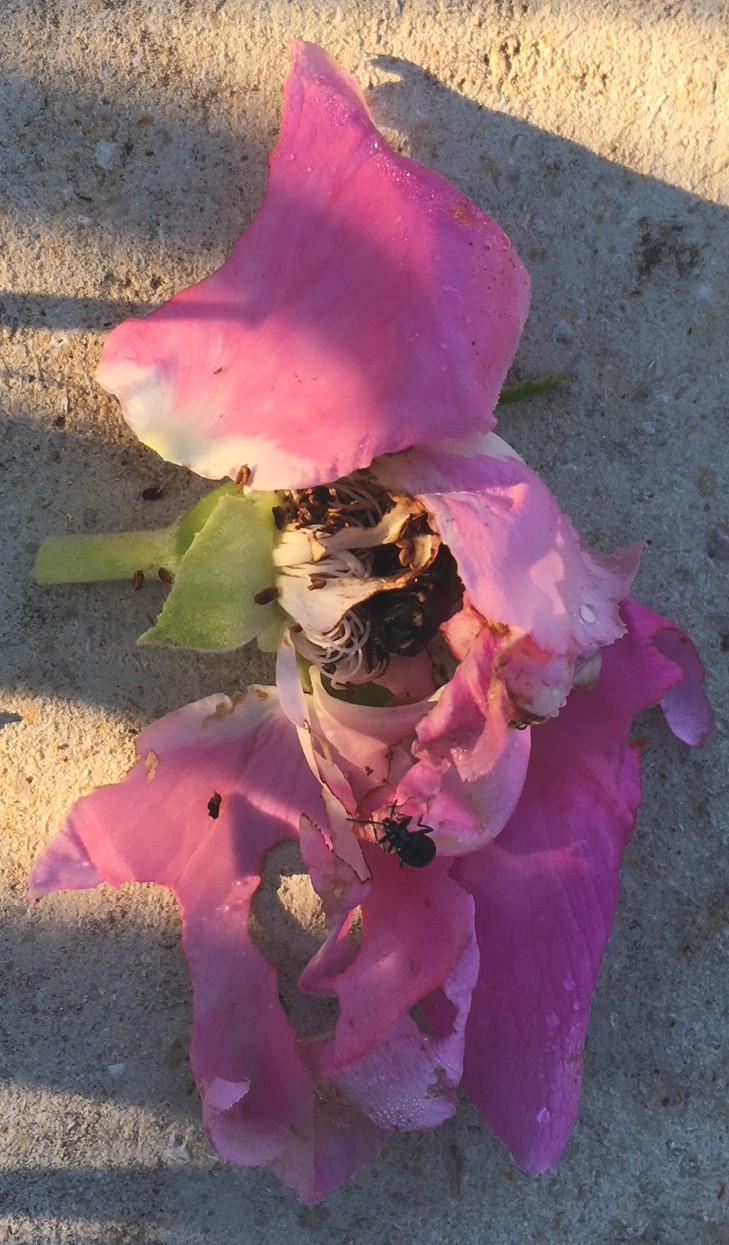
In another more typical picture of the damage that Japanese Beetles can cause to a beautiful bloom, I give you the traumatized bloom of 'Earth Song' that I discovered this morning, seen in the photo at right complete with the Japanese Beetle hiding in the center of the flower (please ignore the Melyrid at the bottom.  I see the latter insects all the time and they don't hurt the flowers).  By the morning of the second day of the 2018 invasion, my total kill is now 14 squished beetles.  Unfortunately, it should have been 15 squished beetles (one male escaped this morning by leaping off the edging brick before I could lower my foot in his direction).

With a little research however, I just tonight discovered that, despite my vaunted prowess as a Japanese Beetle Terminator (Hasta la vista, beetles!), I'm winning a small tactical skirmish, but losing the strategic war.  As if Rose Rosette Disease and Japanese Beetles don't cause enough damage in my garden, the long-nosed brown insect to the left in the first picture above is NOT a harmless flower beetle.  The Internet informs me that it is a Rose Curculio Weevil (Merhynchites bicolor), another flower-eater and civilization destroyer sent to my garden by the demons of hell.  I should be just as diligent handpicking these little snouted monsters as I am the Japanese Beetles, and yet I knew not of their existence prior to this.  It seems to not be enough that I have one beetle enemy, the crunchy critters  have now enlisted allies.  Saints preserve my roses!

Saturday, June 30, 2018

Longhorn Landscape

My neighbor, a man who has reached that life era where one has fully cast aside any concern for societal approval or disapproval (of which I approve and concur), was bound and determined this summer to find someone to put Longhorn cattle on our adjacent pastures.  Ding and Dong, our omnipresent donkeys, were initially another one of his compulsions, although now they are a regular stop on the neighborhood sight-seeing tours and a joy to others; several neighbors come by daily to bring them apples and talk to them.  I suspect the Longhorns will eventually just be another stop on the tour of the eccentric mini-ranches at the edge of town.  They already seem to be the focus of a few extra slow-moving cars on our road each weekend.

Texas Longhorn(s), as the breed is properly known, are descendants of the first cattle brought to the New World by Christopher Columbus and Spanish colonists.  Having learned and repeated that, ProfessorRoush is not even going to contemplate how politically incorrect some might regard that sentence.  It's history, live with it.  Longhorns are extremely suited to drought conditions, and thus have some advantages here over the Angus and other European crossbreeds common to the Flint Hills.    I suspect the matronly horns of several of the cows in this picture are also quite useful to protect their calves from the packs of coyotes that run this area of the Flint Hills every night.

It is probably just an aspect of my academic streak, but I was fascinated to learn that the Texas Longhorn was almost extinct in the late 1920's, saved by the US Forest Service's establishment of a remnant herd in the Wichita Mountains Wildlife Refuge in Oklahoma.  Just like the buffalo, their lease on life has been revised by the increased desire for leaner beef by fickle humans, and by these species ability to thrive in the Plains without man's intervention.  Just like the Butterfly Weed (Asclepias tuberosa) blooming profusely despite this summer's drought in the foreground of the middle photo, above, these Longhorns are doing fine without any worry from me.  In fact, the two, Longhorns and Butterfly Weed, seem to belong together in my greater landscape, don't you think?   

Saturday, June 23, 2018

Awfully Flashy, Indeed

I did not, as I suggested recently, have to wait for my 'Heavenly Flight of Angels' daylily for the "next flashy daylily to come along."  In fact, two days later, it was the semi-awfully, but coincidentally named Hemerocallis 'Awfully Flashy' that captured my instant attention as I took Bella out for her morning wee.

Yes, despite my recent daylily mis-identification,  I'm pretty sure that this is 'Awfully Flashy', because it matches the spot on my plant map and, more importantly, because it matches the internet pictures I can find.  'Awfully Flashy' was a 1979 introduction by Monette and is described as a semi-evergreen diploid with 6.5" blooms of lavender pink blend and a green throat.

I stated my opinion that this daylily was named "semi-awfully" for a couple of reasons.  First, I couldn't resist the pun.  Second, while 'Awfully Flashy' may be flashy, it is certainly not awful. In fact, I'd argue strongly for it as a beauty.  'Fancily Flashy' would have been a better name.   I know that it is not the most modern over-bred, spectacular daylily available, but since I buy the majority of my daylilies as cheap divisions at plant sales, it's about as fancy as I grow.  The upper petals are deep pink, in fact almost fuchsia-pink, compared to the lower petals and they have a prominent lighter midrib and ruffled edges.  Best of all, that green throat has a sweet fragrance.  I'm always surprised by fragrant daylilies, as are undoubtedly some of you, because for some reason daylilies don't draw anyone to sniff them.  Perhaps we are simply put off by the prominent stamens in our way.  Perhaps we feel subconsciously improper sticking our nose in the daylily's business.  Regardless, put away your inhibitions and sample the fragrance of 'Awfully Flashy'.

Although I didn't know it, or have forgotten it, it is evidently "a thing," among daylily fanatics, to write short stories which use as many names of real daylilies as possible.  Maybe this winter, when I have more time, I'll give it a shot, but I'm not going to attempt it now, in the heat of summer, when new daylilies are opening for my pleasure with each new dawn.

Thursday, June 21, 2018

Here's Why (Weather)

Given my post yesterday, some may have thought I was kidding about the weather here.  So, as further evidence, I give you these photos; taken last night around 8:30 p.m.   No rain was predicted, yet this front came sweeping in from our northwest and caught us by surprise.


A few minutes later, you can see that the main wall of the front is going to sweep just to our north (again!) and that the sun is now shining in the direct west. 


On the plus side, as the front went by, the setting sun and the back side of the wall combined on the southeast side of the house into a startling mix of perfect pastel color.


And finished off with a double rainbow to our direct south as the sun set.  Can't ask for more than that.

Except, of course, rain.  We got a sprinkle, enough to make the pavement look wet.  And that was all she wrote.  Wamego, the next proper town east, had a bit of a blow, with a few trees down.


Tuesday, June 19, 2018

Weather Wierdness

I'm normally "ProfessorRoush Proud" that I've become something of a weather guru to Mrs. ProfessorRoush and her friends.  So many years of reading the Kansas sky, smelling the air, and viewing the radar patterns have made me and those around me reasonably confident and comfortable that I can reliably predict the immediate weather patterns and their severity better than the internet or evening newscasts.   I frequently get calls or texts on summer evenings asking me if a friend should take shelter from a dark sky or whether they can go safely to sleep, ample evidence that my meteorological mastery has indeed been recognized by others in my circle. 

Not this year, though.   This morning, Mrs. ProfessorRoush texted me as she was beginning a trail walk with a friend to ask me if it was safe to go despite the dark northern sky.  A quick check of the radar and a look at the movement of the pattern and I told her to go ahead and take a hike.  You can see Manhattan in the screen capture at the right, 8:30 a.m., just at the southern edge of a storm that was moving straight east to west and just to our north.  Mind you, the hourly weather forecast for this zip code showed no rain chances here at all until evening. 

Within an hour, however, we had a pretty stiff downpour on the east side of town, so I knew the west side was getting pummeled.  And look at the radar.  At 9:30 a.m., these patterns were moving stiffly to the northeast.  The previous rain stayed put but moved a little east to touch us, and then a large storm formed south and west of Manhattan and headed directly our way.  None of the lower pattern was even a wisp of color an hour prior.  And, while it was currently sprinkling outside, the internet weather still showed no rain until tonight.

Mrs. ProfessorRoush was not pleased with me.  When I texted and told her there was more coming, she said "I wish you would have looked when I asked."  I think, I think, she just might have believed me when I told her that I had, but she also might suspect that I wouldn't be above a quiet chuckle, sitting in my nice dry office, wondering if her hairdo got drenched.  I'll vow here and now in print, however, that I know better than to pull a little prank at the whims of the Kansas weather.

Monday, June 18, 2018

Splitting the Pot

As a cheap son-of-a-gun frugal individual, ProfessorRoush was not entirely unhappy when the pot containing the  'Heavenly Flight of Angels' daylily that I was purchasing split down one side as I lifted it to carry it to the sales counter.  Yes, it served me with fair notice that the plant was pot-bound, but I also knew I could divide the $10, one-gallon plant and get two decently size plants for the price of one.  I also just couldn't, at any price, resist the combo of a 7" inch yellow spider daylily with white ruffled edges and a fragrance described, in tongue-in-cheek fashion, as "heavenly."   Everyone thinks they're a comedian these days.


And pot-bound it was, in spades.  I normally would divide a plant like this with an old serrated kitchen knife that I purloined from Mrs. ProfessorRoush for just such occasions, or sometimes, as I face a perhaps less dense clump, with simply a garden spade, but in this case I was not going to let pass the opportunity to try out the serrated side of the new Hori Hori hanging right there on my belt.  A few quick strokes of the 6 inch blade and I proved yet another use for the knife and saved myself a trip to the shed for my previous implement of destruction.  I might even surprise Mrs. ProfessorRoush and return the kitchen knife.  


We've been having some blast furnace 100º weather here, hot and sunny, but the beautiful blue skies that accompany the horrid temperatures keep my complaint levels down.  Mama House Sparrow also does not seem to have any complaints, incubating these pretty little eggs in the cool dense shade of our 'Ann' magnolia shrub, about 3 feet off the ground.  I startled the attentive incubatee Mom with my early morning weeding today, but she had returned to the nest the next time I checked, so all is well.


'Ed Brown' (not 'Cream Magic')
I'm actually welcoming the warm temperatures, for once, because we are beginning daylily season and I'd like something to go right this year.  The first few are blooming here now, and I took great pleasure in seeing this beautiful daylily open yesterday, for Father's Day.  My notes tell me it is Hemerocallis 'Cream Magic', although I can't find a picture on the Internet to visually compare it (see addendum below for correction).  The description, however, does match the official "cream flushed pink with greenish cream throat" description, so I'm reasonably certain this is the 1980 cultivar from Lenington-G.  'Cream Magic' is blooming with the 'Stella de Oro's' and a couple of other nondescript cultivars, so she's the "cream" of the ball right now.   Until the next flashy daylily comes along.  Such as my two new clumps of 'Heavenly Flight of Angels'.

Addendum 2018-06-19:  The daylily that I thought was 'Cream Magic', is actually 'Ed Brown', according to the latter's label at the K-State Garden, where I purchased my start and where it was blooming today when I also saw the real 'Cream Magic' blooming.  So much for interpreting written descriptions without photographs.  To straighten out my daylily maps at home is an impossible task.  The real 'Cream Magic' is pictured here, to the left, for Internet prosperity.

Friday, June 15, 2018

Elm Excogitation

I took a walk today, a "noon constitutional" as it might have been termed in another more gracious age.  I took a walk and strode in a single instant from complacency to sorrow, contentment to loss.  From sunlight into the shade of a massive American elm was only a few steps for a man, but a mile for my mindset.

As gardeners we all, I'm sure, know of the previously ubiquitous American Elm and the disastrous impact of Dutch Elm disease on the species.  Intellectually, we understand that the American Elm (Elmus americana) was a valued tree in the landscapes of the 19th and early 20th centuries, so-called "tabernacles of the air."  Viscerally, however, gardeners of my age have no memories of a cool picnic under the elms or the spreading chestnuts of history.  Our blood does not stir from loss of such things as we've never experienced.

On this 96ºF sunny day, however, I ambled to the K-State Gardens and, passing under the massive canopy of its surviving and much-pampered American Elm, was instantly struck by the stark drop in temperature and stress I experienced.  If it wasn't 20 degrees cooler under the tree than in the sun, then I'm a mange-ridden gopher.  I understand now, acutely and intimately, what civilization lost when DED was "accidentally" introduced through the hubris of man.  The K-State Gardens elm was planted in 1930, is currently 60' tall, and requires $1000 injections to prevent Dutch Elm every 2.5 years.  While it seems presently healthy, I'm not encouraged for its long-term survival, knowing that administrators and politicians inevitably appropriate every possible dollar for their own pet projects and needs. 

In our callous daily existences, we don't often emotionally feel the tragic loss of a unique species of rainforest frog, or the potential extinction of a subspecies of rhinoceros, but you CAN come to K-State and experience with me the last years of the American Elm.  Echoing and borrowing the sentiment from an excellent essay by astrophysist Dr. Adam Frank that I read this week, I would say that the Earth will survive, but the Elm may not.  The Anthropocene HAS arrived and we should perhaps better start to contemplate that our time is measured, just as the elm's.   

Sunday, June 10, 2018

The Cutting Edge

ProfessorRoush is not an innovator.  He has not, does not, nor will not ever claim to be an early adopter of technology.  Yes, in the early 1980's I took to computers like a duck to water, but as a moderately dexterous manual typist (and "Kelly Girl" for approximately 2 days before I found more manly employment), computers were simply a convenience and a logical next step to a logic-inclined mind.  And so it is that it has taken me all these years of gardening to purchase am actual Hori Hori, a so-called Japanese gardening knife.

My garden knife itch has been half-formed for years, curiosity capturing the crusty gardener's conscious thought, but took full force this spring, and I began a search for a proper Hori Hori knife.  Locally, there was little to satisfy my thirst, only plastic-handled half-creations or mass-produced garden butter-knives to be found.  On-line, of course, the possibilities became endless as I sorted through sheaths and steel alloys and sharpnesses.  I became self-educated on tangs and enraptured by rivets.  Heft and handles were considered with heavy import.

Ultimately, I chose the Truly Garden Hori Hori knife for $26.38, although this design looked similar to many others (Duluth Trading, LifeWell etc) which are all likely of Chinese manufacture.  Comprised of 420 stainless steel, it has a full tang for strength, hardwood handle, and three rivets (many have two) for strength.  It is marked both in inches and millimeters, has a curved surface for easy plunging into soil or enemy, and has both a sharp edge (very sharp, as advertised) and a saw-toothed edge.  It came with a massive leather sheath and a free diamond sharpener, bonuses that seemed worth the extra few dollars above the $19.99 nylon-sheathed offerings.

My only question now is, "What took me so long?"   In just a few weeks, it has become my constant gardening companion, constantly sheathed at my side like a sword on a Crusader.  Plunge it into the soil next to the weed, even into my rocky soil,and a simple twist of the sharp edge towards the weed stem delivers most of the root into your hands.  The curved surface has made it useful as a planting tool for transplants.  I've used it as a short machete on thistles, to saw small limbs, prune new shrubs and to cut packages and twine and cable ties at abandon.  I haven't yet needed the measurement markings, but I suppose they will save me a walk to the barn the next time I have a need to measure something in the neighborhood of 6 inches long.  Its weight and balance are perfect, solid strength symbiotically matched to exquisite sharpness.  My only complaint is that, as a lefty, I'd like the sharp side and the saw-toothed side reversed.  

I was picky about my choice of a Hori Hori because I was thinking of a provenance, a hand-me-down designed to reach future generations.  I can already tell, however, that this one won't be passed down in mint condition, but with that wonderful patina of use that proclaims its real value.  The heirloom will have to be my other garden knife, a rose pruning knife with a rosewood handle, also of full tang and three rivets.  I purchased it years ago and it has gone unused beyond occasional covetous fondling and oiling.  It never became the rose grafting knife that I intended, I suppose because my hands and gardening are more suited to dirt stabbing than fine pruning. 

LinkWithin

Related Posts Plugin for WordPress, Blogger...