Sunday, October 31, 2021

Autumn Cometh

Hi, Everyone!   I apologize for the long lapse in posting, but autumn has been moving along and the world is streaming past my eyes at the speed of life.   

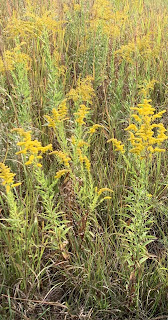
Both Mrs. ProfessorRoush and I agree (for once) that this fall has been a colorful one in Kansas; despite the national media predicting poor autumn displays in the usual tourist spots, we've been fortunate here.   As you can see from the back yard, photographed above last Wednesday, the prairie grass has great color this year and the garden is settling in and ready for cold.   And the cold is coming this week, lows down to 30º, highs in the 50's.  We should finally see a fairly hard freeze to shut down the final growth mania.

I hope, however, that this Aster frikartii ‘Flora’s Delight’ somehow survives the frosts.  I don't believe I've mentioned it before, but it's been a garden stalwart since 2004.  I seldom pay this plant much positive attention until now, when it lights up a corner of my front bed to the right of the sidewalk.  I spend most of the spring ripping it out and keeping it within a 6 foot diameter area.  It's one of those plants which should come with a hazardous warning label, but most web sources about it only suggest that it makes a good "container" plant.   Oh, yes it does, because if it isn't in a container it makes a fairly tall invasive groundcover to about a foot high!  By July, however, it stops being a bother and I forget all about it.  

I forget about it until now when those soft lavender blue blooms highlight those bright yellow centers and catch my eye.  Aster frikartii is also attractive to bees and is probably one of their last source of nectar before winter.   This cold bumbler stood fairly still for the camera, not moving until I almost touched it.  And now I feel guilty because I should have let this aster spread and bloom more; for the bees, you see.

We finally, finally received a nice rain this week, about 3.6 inches total over a long night and day of rain, so I hope the garden will go into another Kansas winter well-hydrated and ready to rest.  

And I hope the garden stops the weird antics that fall sometimes brings.  I've been worried about the row of lilacs to the west of the driveway pad.  Several of them, primarily the older Syringa vulgaris, have leafed out some of those precious green buds after they dropped their summer leaves and a couple even bloomed, like this 'Nazecker' light blue lilac.  I won't minimize the sublime joys of smelling lilacs in October, but I also don't need to constantly feel like they've sacrificed their last for me.  I suppose the chance always exists that I won't be around to smell lilacs next spring, but I'm planning to be here when the snows melt and the lilacs bloom next April, the world right and everything in its own time, just as it should be.

Friday, October 1, 2021

Maximum Sunflower Power

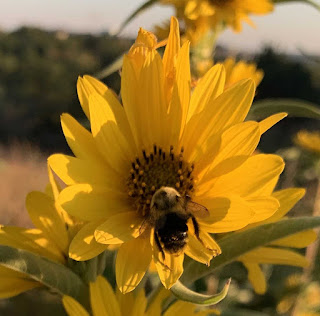
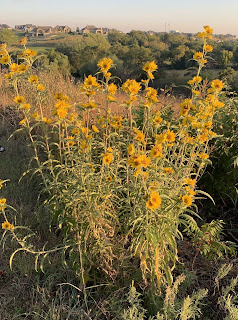
 Ladies and Gentlemen, boys and girls, dogs and bees, I give you the crowning glory of the Kansas fall prairie, the Maximilian Sunflower (Helianthus maximiliani).   On the prairie near me right now, one can see lots of yellow flowers blooming, foremost being the light-yellow green of the native goldenrods, but nothing outshines or is taller than the Maximilian sunflowers.   Standing out hundreds of feet away, each clump betrays the location of a site of disturbed earth, the sunflower a sure marker of soil chaos.   Bees and humans alike are drawn to it, the screaming color calling across the ocean of drying prairie grasses.

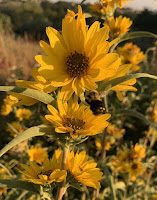
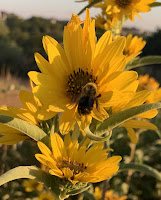
This clump came up near my burn pile.   There's a smaller group in the middle of the unmown area of the back yard (my so-called "rain garden"), but it is this plant at the back edge of the garden that begs for attention.  And, as you can see above, it got attention from this very busy bee photobombing the flower.  It also got attention from Mrs. ProfessorRoush, who posed with it for me, but I will not share the beauty of the former in this blog, Internet privacy and all being what it is.  I found it interesting that the sunflower and Mrs. ProfessorRoush are almost identical in height, 5 feet tall or so.


The bumblebee that attacked these members of the Aster family was fortuitous for my camera, arriving just as I moved in to photograph the flower closely.  In a month these flowers will be bountiful seedheads, full of energy and a good forage crop for livestock and deer.  

You can see here what I mean about the goldenrod.  I'm not good enough at quick identification to tell you if this is Prairie Goldenrod or Canada Goldenrod or another species, but this is as yellow as it gets and the brightness fades quickly like the plants in the background here.  

Between the bad press given to goldenrod, and the happy beaming face of the Maximilian Sunflower, I've got to choose the sunflower every time.   And so, it seems do the bees.  The only insect I've ever seen on goldenrod around here are the goldenrod soldier beetles.


Sunday, September 19, 2021

Blue Draperies

The slothful side of ProfessorRoush unabashedly slithers up in late August each year.   As September slowly slides in, I tire of mowing and weeding and trimming, all too ready for the garden to frost over, to die away and let me rest.   It's now that the morning glories seize their chance, rampantly growing over everything in sight and transforming the garden into a blue oasis of heaven. 

In point of fact, I don't know if my ubiquitous morning glories are the 'Heavenly Blue' cultivar of the species or just the wild Kansas Ivy-Leafed Morning Glory (Ipomoea hederacea), but they are everywhere.  They invade quickly when I stop weeding in July, when I am weary of the gardening battle, and they take advantage of my weakness to drape every plant within reach.  And I let them, for I treasure that light sky blue shade above all hues in my garden.

I was struck recently by the combination of the morning glory with the Canadian rose 'Winnepeg Parks' (above), the surreal, otherworldly blue morning glory jarringly visible against the pink rose, clashing across the color wheel to a striking contrast.  'Winnepeg Parks' is a Parkland series Canadian, unfailing blackspot free in my climate and a reliable periodic bloomer.   Growing into another rose, chaste 'Morden Blush', Ipomoea blends much better, a companionly match of color for a calming scene.


Even the tired foliage of variegated euonymous 'Moonshadow' is improved by a little "morning glory."   This picture at the right, suitable for framed artwork against the right light blue wall, just pleased me to no end as I took it.  I missed capturing, however, the bees that were darting in and out of the blossoms, the bumblebees every bit as appreciative of the morning glory as I am.   In the early morning right now, two plants draw the bees;  morning glory and caryopteris; both blue and beautiful.   However early I join the garden, the bees are already there.

Two or three weeks after I took the first picture above, the morning glories and caryopteris are still going strong, now lending their gentle contrast to the tall sedums, neighbors by location, opposites of plant physiolgy.  You have to get up pretty early to catch the sky blue delicate blooms, as they close when the sun begins to shine with any vigor, but the tougher sedums that support them continue on each day, oblivious to the sun, "feeling the burn," as it were.  ProfessorRoush enjoys both lives, early to rise and walk, thriving in the sun, and resting at night in preparation to bloom yet another day. 

Sunday, September 12, 2021

Mrs. PR and the Bumblebees

Friends, ProfessorRoush failed you miserably today, too weak in a critical moment to do what really needed to be done.  I failed to capture and share with you the video of a lifetime, a sure bet to spread like a virus across the globe, making ProfessorRoush a household name in the process.  

My Sunday began in a completely innocent fashion with no clue of the drama to unfold.   As I was preparing to mow the lawn, Mrs. ProfessorRoush mentioned that she was going to slip down to pick any remaining tomatoes in the garden before she showered and began her day.   Ever the helpful and attentive husband, I followed her down to the garden, where we picked a few tomatoes, snared a few deliciously ripe blackberries from the thorny canes, and then ambled over to the grapes, which were past ripe, sweet and juicy, and needed picking.

Let me set the scene for you.  As it happened, Mrs. ProfessorRoush had ambled down to the garden in a mid-thigh length pink cotton nightgown and slippers, her tanned legs bare and well-toned, a beauty among the brambles.   She was picking grapes off one vine while I, ten feet away, was distracted from her heavenly presence in the garden by the discovery that bumblebees were feasting heavily on the grapes (see the photo above and to the left).  

I was contemplating that astounding new bit of knowledge and engrossed in photographing one of the bees eating the grapes when Mrs. ProfesssorRoush began to complain that the bees were bothering her; complaints that turned quickly to excited chatter and then hysteria as the bees decided that the exposed hair and flesh of Mrs. PR seemed to be even more delicious than the bountiful grapes all around.   Perhaps it was her hair spray, perhaps it was her perfume, or perhaps it was just the delicious sweetness that is Mrs. ProfessorRoush, but those bees were dead set on either driving her away from their sweet grapes, or feasting on her, or both.

Now picture this:  a frantic Mrs. ProfessorRoush running up the hill in a mid-thigh pink-nightgown, arms flailing madly, the bowl of tomatoes and grapes cast upon the ground, Bella trotting calmly behind her, wondering at last, I'm sure, if she was going to finally see her rival for my affections dethroned.

And there I was, phone in hand, with it already turned on in camera mode, and I was laughing so hard I could barely stand, let alone thinking clearly enough to capture a photo or a movie for the future entertainment of humankind.  In hindsight, I'm so disappointed in myself.   Perhaps I wouldn't have become famous for a video, but I'm sure the pink blur of Mrs. ProfessorRoush's backside running up the hill would have at least made the nightly national news.  And perhaps distracted and amused, for just a moment, an entire nation bored from the pandemic. 

So, there you have it.  Bumblebees eat ripe grapes, I presume for the sugar and cheap energy.  I had never heard or read of that before.  And I've spent the day outside doing chores and snapping other pictures, like the last two photos of the bees on the light blue caryopteris near the back steps.  I remain hopeful that by nightfall my laughter will have faded from Mrs. ProfessorRoush's memory and she'll unlock the doors.  Surely she'll be able to see the broader humor of the occasion by then, won't she? 

Sunday, September 5, 2021

Webs in the Mist

ProfessorRoush was surely not planning on this topic for a blog as he woke and schemed the day ahead, but opportunities arise and their urgency cannot, sometimes, be denied.  I woke early, more so to enjoy the predicted cool morning and was not disappointed.  So long, we've waited for the onset of cooler morning and the feel of fall and here it was, at last manifest and perfect, 61ºF as I rose.   Bella and I woke and stumbled out to a paradise dampened by recent ample rains and more.


I was caught and mesmerized by the industriousness represented in the spider's web above, this dew-bejeweled engineering marvel stretched between the stiff dead stems.  The web is tiny, no bigger than my hand, but yet perfectly designed to catch an unwary small insect.   Not so this nearby web pictured at left, a chaos of construction, haphazard strands of spider goo placed at random angles and spacings.   What meaning, I wonder, in the diversity?   Is one spider so more industrious, more meticulous in its intent and implementation, the other a mere slob, unconcerned for convention and fashion?   Was the second spider distracted from his chore or merely indifferent to the task at hand?  Or am I simply wrong, imposing my own judgments and ignorance on the task?  Is the second spider the genius, the creator of a chandelier of new artistry and evolution, its value unrecognized by the half-witted human?  Why does order seem more perfect than disorder, entropy aside?

Regardless, neither spider will be fed this morning, the morning dew defiling the web's purpose and unsticking the sticky strands, no harvest to pluck from the traps.  And both illustrate a new ecosystem in my front beds, an opportunity created from the tall brown stems of Knautia macedonica, an unforeseen profit of its profligacy and a monument to the natural order of nature.      


It is not only grass and plant heavy with dew this morning, the very air is saturated, the warm ground giving back the recent rains we've had to the cool air.   My back yard above, the photo facing south, and front yard below, the photo facing north, are both cloaked in fog, hidden from the world and blanketed with quiet.  The sun is up, but nearly invisible, shuttered by the mist, no wind to clear a path for it to reach us and the world another world away.   I give you a perfect moment of the beginning of fall weather here in the Flint Hills, brought to you by mist, dew, and the lens of my iPhone.  

Sunday, August 29, 2021

Red August

Here in the furnace of August, with the grass dry and crumbling beneath my step, my garden glows red in the hot sunshine, concentrating and sending back the searing rays towards the cloudless skies. While the garden bakes in the heat, some plants thrive and bloom, sneering back their indifference to the heat.  All seem to be either red or white and today, I'll feature the red.  Next week, perhaps the white.  Or another week.  White is always there in the garden, but seldom noticed, isn't it?

'Centennial Spirit'
Always 'Centennial Spirit', pictured above and at left, blooms this time of the year, a crape myrtle that returns reliably in my climate, every year nearly the brightest red in my climate.   Brighter in the sunlight, as in the photo above, this particular shrub has survived two fires this year, for it lives in the garden bed that was caught in this year's spring burn, literally rising from the ashes of April to shine brightly as always, blooming right on time.   I rely on such specimens at this time of year, regular beauties to distract from the general lack of bloom when the heat soars.   And 'Centennial Spirit' never disappoints me.  


'Champlain'
I carefully wrote "nearly the brightest red" above because the Canadian rose 'Champlain' never allows itself to be outdone by a plant that only blooms in August.   'Champlain' is nearly always in bloom, a shorter shrub rose than most to be sure, but all the more prolific with its blooms despite its dwarf size.  'Champlain' is blooming its head off right now, defiant to the bleaching rays of the sun, bright red and healthy until it's petals drop.  I have two 'Champlain's now, both survivors of Rose Rosette and both blooming cheerfully every day through the summer.  This photo of 'Champlain' also made me realize that somewhere along the line, Apple must have improved their camera's handling of red tones.  I can't ask for a better red than this from my photos.


'Cherry Dazzle'
Other reds are out there in the garden, less red than 'Champlain' or 'Centennial Spirit' perhaps, but red never-the-less.  'Basye's Purple rose' has had a rough couple of years, losing large canes while gaining others, but its normal deep purple blooms take on a more red tinge in the heat, the yellow stamens struggling to stand in the low humidity.   And then there is another crape myrtle that draws attention from my bedroom window, the very short and red-of-another-mother 'Cherry Dazzle'.   Every year, I worry that it will return from the dry sticks that mark its presence in winter, yet every summer it puffs up and blooms  a more-near, slightly-pinker echo of the larger 'Centennial Spirit' down in the garden.
Basye's Purple Rose


'Midnight Marvel'
I'll leave you, envious no doubt of the red fires in my garden this fall, with this closeup of 'Midnight Marvel', a bright red hibiscus with burgundy foliage that is still blooming a month after it started.   The largest flower in my garden, 'Midnight Marvel' is often the size of a dinner-plate, drawing bees from acres away to feast on this stalk of pollen.  And drawing my eye from across the garden, a "stop sign" planted to make me stop and admire its scarlet beauty.


Saturday, August 21, 2021

Flawed Beauty

ProfessorRoush is polling today (or is it trolling?) with a troubling question for my blog readers.  

Gardeners, do you prefer the captured images of beauty in your garden au naturel, or touched up to hide the blemishes and traumas of living?  Should the photographs we bloggers take of our gardens be posted unaltered, or should they be released onto the internet as posed and filtered and airbrushed as Cindy Crawford on the cover of Vogue?  Are we ready for the naked truth of our gardens, for the blatant blemishes of foliage or flower, for the ravages of wind and sun and rain?  Is the Venus de Milo an ageless perfection in marble or merely one more damaged chunk of rock?

Nearly all of the photos that ProfessorRoush posts here are unaltered except for some cropping and for a few taken after I pulled the surrounding forest of weeds  and only then "snapped" the photo (do we still "snap" photos or do we just focus and tap?).   Is pre-pulling the weeds a mortal sin of nondisclosure of the truth of my garden or merely a permissible act of vanity and understandable attempt to avoid embarrassment for my gardening sloth?   I'm facing the question today as I post the nearly perfect combination of white 'David' phlox and the 'Alaska' Shasta daisies displayed in the top photo and the unaltered reality here of the vista at the left.   I took the left photograph before removing the dead and brown spent flowers from the area and posing the top photograph.   Yes, I could have done even better if I had cut the unobtrusive bare stems away, but which is really the better photograph?  Nature in all its raw glory at left or the gussied up and primped "Still Life of White Flowers" at the top?

The broad question vexing me today is so simple in essence but has so many permutations in practice.   The aforementioned Cindy Crawford is a beautiful woman, but famous as well for the flaw in her beauty, the melanocytic nevus we commonly refer to as a beauty mark.   In fact, google "beauty mark" and a picture of Cindy will pop up alongside the listings, an icon for that concept of a minor flaw perfecting the person.   Does that same concept extend to our gardens?   Is the picture at the right of this Knautia macedonica blossom struggling up through the phlox somehow more beautiful than that of the simple and pure virginal white phlox in the photo below?   As garden photographers, do we need to add mouches to our perfect photos to make them yet more perfect?

ProfessorRoush is so full of questions today, eh?  So deeply troubled about photographic nuance and so immersed in disturbing philosophical discourse unbecoming of a cool and sun-lit Saturday morning here in the Flint Hills. I know that many come to this blog for entertainment and answers and yet here I am, the snake bound to ruin Eden and cast you out into uncertainty and unease.  I leave you today only with my questions, a complete dearth of assuring answers, and my hope that this photo of the clean and white 'David' phlox will soothe the disturbance of your soul.     

Friday, August 6, 2021

Spiritual Prairie Union

 "The heavens declare the glory of God and the firmament sheweth his handywork." Psalm 19:1.  

If a gardener knows any scripture at all, it should be this phrase.  ProfessorRoush has been witness to the wisdom of this Psalm every morning this past two weeks as I drive past a gorgeous heavenly display of two common prairie forbs sharing the same space, purple Western Ironweed (Vernonia baldwinii) and white and green Snow-On-The-Mountain (Euphorbia marginata).   There are few times when I see such showy native plants so wild, yet so perfectly sited to contrast and enhance each other that I can only stand and marvel, jealous of the Gardener who arranged them in combination.


Western Ironweed
I took the picture above in the worst possible conditions for photography; sun setting behind the subject, light rain on the horizon, dusk settling into the valleys.   And yet the beauty of the prairie shines forth from this chance clumping, this union of the blooms of August each drawing in their late pollinators, offering last seasonal meals in exchange for stirred chromosomes, the dance of wildflower and insect continued in another year.


Snow-On-The-Mountain
Neither of the colorful perennials above are rare on the prairie.   Western Ironweed, so drought tolerant and tall in the heat of summer, is a common pasture weed on the Flint Hills and difficult to eliminate from my garden beds.  This member of the Asteraceae is shunned by cattle for its bitter taste, who thus help it to spread in overgrazed pastures, eliminating its competitors while letting it grow.  Snow-On-The Mountain, a poinsettia relative, is also found here in nearly every disturbed spot of ground, popping up randomly in my garden beds next to grasses and roses, and anywhere else it can find a bit of moisture and sunshine.  In contrast to the ironweed, this euphorbia pulls easily from the ground with bare hands, and although it's bitter, milky sap is said to be as irritating as poison ivy, I seem to be impervious to its toxic nature.

The ubiquity of these wildflowers might suggest that their serendipitous adjacency has occurred by mere statistical chance, but I refuse to tempt disaster by agreeing.  ProfessorRoush, not normally disposed to quote scripture, nonetheless feels here a higher design, a greater Hand in this natural combination.  Maybe you have to be here, at this spot, with the waning sunlight and smell of rain in the air to appreciate this moment.  Better yet the sight is simply spectacular every morning with fresh sunlight and cool breeze and living prairie all around as I drive to work.  All I know for sure is that these two plants, every day, brighten my morning, the gift of living made manifest as my day begins.  And I am thankful for it and for my life shared with the prairie.

Saturday, July 31, 2021

New Life, New Roses

You know how it is with proud new fathers, right?  Every gurgle, every smile, every first step of the infant is celebrated, photographed, and immortalized?   Well, ProfessorRoush  is absolutely no different with his infant roses, chronicling every new leaf and fretting over every new threat.  

The gorgeous little blush pink darling seen here to the right is the second bloom of one of two seedlings I was able to keep alive this year, from the first tiny sprout in late February clear through to transplantation into the garden proper.  I'm disturbed that I had better light this morning (see the movie at the bottom), but had my iPhone set to "video" and when I went to rephotograph her for this afternoon, the weather is cloudy, and sprinkling, and the light is terrible for her.  

Her first bloom, shown to the left as she opened in late April, showed me a lot of promise, a full double with delicate petals of a faint pink hue, but I am more thrilled to see now that she is remonant, blooming again today with two other buds waiting in the wings.

She's been healthy so far, protected from the rabbits by her milk jug collar and under full Kansas sun, and the bloom at the top appears undamaged by our heat and the rain, but of course she has to go a long way to prove herself before I trouble to name her.  Most important will be her winter hardiness, for I will not protect her from weather, just from marauding deer as the fall approaches.   A chicken wire cage is coming soon!


I have another new seedling, planted a few yards away, also healthy but she has yet to bloom.  Of course, I have no idea of the provenance of either rose although the foliage of each resembles its sister; both are the unknown orphans of a bunch of rose hips gathered in a hurry as the winter closed in and planted into a peat moss garden in the house under artificial lights.  Most of the hips were from Hybrid Rugosas, but neither seedling shows any signs yet of Rugosa heritage.  From her appearance, the one that has bloomed looks most like the English Rose 'Heritage' from my garden, the same delicate petals, similar bloom color and leaf form.  Sadly, I have no idea if I grabbed hips from 'Heritage' during my fall frenzy.


Keep your fingers crossed, my friends, and I'm open to suggestions for naming and for christening presents from godparents.  I gave both roses some extra water today after our week of 100ºF+ temperatures and dry conditions, but otherwise, they're on their own.  At least the Japanese Beetles have disappeared, their summer cycle of irritating this gardener at an end.  

LinkWithin

Related Posts Plugin for WordPress, Blogger...